Trade War at Sunrise: The Value of Maintaining Perspective on the Trade War
Christopher Sands is Director of the Center for U.S.-Canada Studies at the Johns Hopkins University School of Advanced International Studies (SAIS)
The new phase in the U.S.-Canada trade war came like bankruptcy to Mike Campbell, a character in Ernest Hemingway’s 1926 novel The Sun Also Rises: gradually, then suddenly.
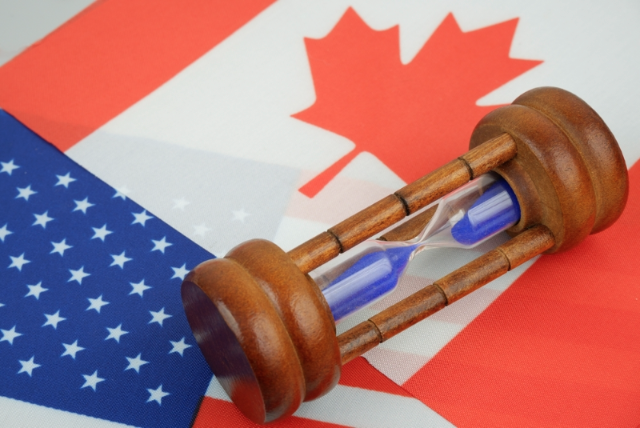
President Donald Trump imposed tariffs on imports from Canada, China, and Mexico under the International Emergency Economic Powers Act of 1977 (IEEPA) in February 2025 and used the same authority for the “Liberation Day” tariffs on Canada on April 2, 2025. The administration’s use of that authority was challenged in court. After the administration lost and appealed, the case reached the Supreme Court, which ruled against it on February 20, 2026. The administration replaced the IEEPA tariffs with new tariffs under Section 122 of the Trade Act of 1974, a time-limited provision. Justice Brett Kavanaugh’s opinion in the IEEPA case noted that tariffs under Section 338 of the Trade Act of 1930 were available as an alternative, and the administration announced that Section 338 tariffs on Canadian products would take effect August 19. A three-day reprieve and positive comments from President Trump raised hopes for a deal but talks broke down after markets closed on August 21 and the United States imposed the tariffs. Canada has pledged retaliatory tariffs on U.S. products beginning September 8, and the United States has promised additional tariffs in response. The gradual accumulation of U.S. tariffs on Canadian products became too much. For many people, the trade war began suddenly when Canada refused to accept U.S. terms for a deal.
The title of Hemingway’s novel comes from the Bible. Ecclesiastes 1:5 is rendered in the New International Version, common to both Canada and the United States, as “The sun rises and the sun sets, and hurries back to where it rises.” It reminds me of the cycles of life and the natural order of things.
Trade talks have cycles, too. They flow from complaints and investigations to threats of trade action, which bring talks with trade partners. The closer the parties get to an agreement, the more dramatic the rhetoric becomes. There are walkouts, accusations of unfairness, and words spoken in anger that reflect frustration rather than considered judgment. Sometimes a deal follows: officials smile and accentuate the positive. Other times there is no deal, the situation worsens, until the sides reluctantly talk again.
None of this is surprising, nor does saying so trivialize the economic stakes. I offer it for the sake of perspective. Trade negotiations are serious and have serious consequences, but they also contain elements of theater, much like the courtroom dramas presented in documentaries and television shows. Focusing on dramatic language can make anyone lose the plot that matters most.
Trade talks between the United States and Canada are different now from when I was in college and the Canada-U.S. Free Trade Agreement was being negotiated. Technology brings us closer to the action than ever before. The data one country gathers and presents to justify new tariffs are available online. Instead of occasional updates on talks, both sides issue a stream of media releases and social media posts. And, continuing a traditional practice, leaks from one side or the other drive headlines and sometimes markets.
This matters because the United States and Canada are democracies. Both governments work to convince voters that the negotiation is necessary and that their actions against the other country are justified. If voters think it is time to settle, holding the line can be difficult, and both sides know it. That is why terrible threats and insults have moved from behind closed doors onto our phones as news alerts, then to social media, where they are debated, dissected, and replayed. I have known many trade negotiators personally. They tell me the threats and harsh tone are not new; what is new is the public’s exposure to them and our struggle to make sense of them. More than ever, we need perspective.
History provides one source of it. The United States and Canada have fought over tariffs and trade for most of their history, just as domestic politics in both countries has long included debates over taxes. After World War II, the United States was the world’s leading producer of nearly everything, and U.S. policy shifted toward trade liberalization – tax cuts on trade – in global markets where Americans wanted to sell. Canada, like many countries, sought to protect jobs and industries through tariffs, government subsidies, and other measures. The United States fought those measures and gradually persuaded Canada to lower its tariffs. Now the Trump administration believes that removing U.S. tariffs left workers and strategic industries unprotected while China and other countries expanded production and attracted jobs in pursuit of “export-led growth”. It is reimposing tariffs to reverse those shifts. This is a change, but it is not U.S. hypocrisy. Although the administration brought tariffs back dramatically, tariffs and trade disputes also occurred under Bill Clinton, George W. Bush, and Barack Obama. Joseph Biden kept many of Trump’s first-term tariffs in place, particularly those on China. Gradual change, suddenly impossible to ignore.
Another source of perspective comes from paying attention to how things are made. “Supply chains” may be a fashionable new term, but the practice it describes has been standard for more than a century. Firms make components of other products, just as a dairy farmer produces milk used in ice cream. Through innovation and specialization, firms become very good at making one thing. Businesses that need that thing for a more complex product seek out those excellent producers. The relationships among these firms form a production or supply chain.
Technology has changed how supply chains form. Today it is easier to find the best producer of something you need almost anywhere in the world. “Best” is subjective, though it is reflected in prices. A low price can signal efficiency or shoddy quality, even the use of forced labor – modern slavery – to reduce costs. This is where government regulations and standards matter. If you produce to a high standard at a higher cost, tariffs can protect you from unfair competition. But what constitutes “unfair” competition? Lower taxes in some countries, or government subsidies to businesses? Such questions are debated in trade disputes and accompanied by drama, but trade between jurisdictions has always raised questions of fair competition, as it should. Unless we live under one world government with uniform rules, those differences will be debated. Our ability to follow the debate more closely than ever does not mean things are worse.
A third source of perspective is one I am only beginning to develop in my own thinking: the effect of technology on trade debates. There is an enormous amount of trade data, along with a growing movement to use artificial intelligence to make supply chains more efficient. Just as online data changed trade by helping firms find the best suppliers for the components they needed, rapid analysis of available data could allow supply chains to adjust in seconds for peak efficiency. But in those same seconds, AI could judge a small business or a factory in your town imperfect, exclude it from supply chains, and effectively starve it to death.
Now consider data integrity. Could a hacker alter a number that prompts an AI system to eject a firm from supply chains? Yes, with devastating consequences. The hacker might own stock in a rival firm and profit. Hostile governments might also manipulate data to remain competitive or to do what Trump has warned about: shift strategic industries away from the United States and Canada, weakening us while they grow stronger.
As frightening as that scenario is, our intelligence agencies warn that hostile foreign governments are already sponsoring social media campaigns to influence political debate. When the drama of a trade negotiation sweeps across news feeds, falsehoods, exaggerations, and passionate feelings are turbocharged; algorithms do the rest. We lose perspective on the trade issues themselves and focus instead on the survival of our countries and communities.
During the Cold War, the United States used disinformation to destabilize authoritarian countries such as the Soviet Union. Our intelligence agencies spread rumors of rebels in the countryside or disloyal generals around dictators to keep adversaries off balance. Dictators depend on control to remain in power, so rumors of emerging opposition were effective.
The American and Canadian governments worry about public opinion because they depend on winning elections to remain in office. Hostile countries can now use technology to keep us divided and off balance. Some will say this is only fair – that we deserve it – but I believe we are the good guys because we value individual freedom and liberty. If we want to keep those things, we must be smarter about what we see online and what we believe. This, too, is why perspective matters.
Each of these cycles – trade-negotiation theatrics, supply chains and government interventions, democratic debate and foreign manipulation – has changed dramatically with technology, yet we rarely recognize it. For younger voters, new technology and its effects are more familiar than the trade debates of the nineteenth and twentieth centuries. That brings me back to Ecclesiastes and Hemingway.
Ecclesiastes 1:5 reminds us that life moves in cycles that ebb and flow naturally, and that we should focus on God and what does not change. It underscores the difference between our short human lives and the infinite nature of God. In today’s terms, we go to school, start a family and a career, put down roots and take on a mortgage, grow old, navigate health problems, and then pass on.
But Ecclesiastes assumed a slower progression through the seasons of the year and of life than the one we experience now. Technology reshapes our lives around ever-shorter news cycles. The noise and anger conveyed by news sites and social media have led many of my friends outside Washington, D.C., to unplug from it all. It is exhausting even for me. In a week like this, they might send me a message and ask how I am doing, expecting me to be busy but caring more about me than about my latest policy paper or hot take on whatever President Trump has just posted.
Many Canadians far from Ottawa politics and trade talks are not unplugging, they are angry. They are angry at President Trump because of what he has said and done, but they are also angry at the United States and even at Americans. It starts with Trump, but they ask: How could so many Americans have voted for him? Trump insults Canada and says it should become the 51st state, yet most Americans are silent. Some Americans say they do not take Trump seriously; others excuse it as his poor attempt at humor.
Over the past twelve months, as U.S. tariff actions advanced through the political process and the courts and the United States-Mexico-Canada Agreement (USMCA) underwent its six-year review, Canadians gradually grew angrier. Many stopped coming to the United States. Others sold property, skipped family and college reunions, or chose to follow U.S. sports teams online rather than attend games. The effect of these boycotts is noticeable in many communities where Canadians had been regular visitors and customers.
And yet this Canadian response was the international-relations equivalent of giving a trade partner the silent treatment. When you give someone the silent treatment and they do not notice, the situation can escalate quickly. Gradually, ordinary Canadians became angry first at Trump and then at ordinary Americans for failing to see how hurt they were. Suddenly, we are in a trade war. Hemingway would not be surprised.
The breakdown in U.S.-Canada trade talks brings together all the factors that shape how we perceive tariffs and international trade disagreements, understand the roots of our prosperity as countries and individuals, and talk with one another about public policy. Canadians who lament American disengagement may be mistaking Americans’ withdrawal from the melodrama for indifference. Political leaders in Washington and Ottawa who try to repair their relationship after the trade war ends will discover that the relationship between Americans and Canadians must be repaired first.
To read the full article as it was published by the US Canada Observer, please click here.
Get the Latest on Trade Policy Insights and Discussions