



WITA’s Friday Exchange: Constructive, Strategic, Stability: Decoding the Trump-Xi Pomp and Circumstance
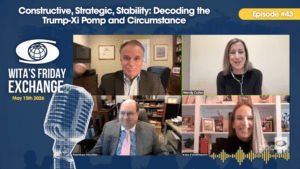
After much anticipation the Trump-Xi summit in Beijing turned out to be heavy on atmospherics but light on substance. After doing the YMCA at the state dinner, the two super-powers seemed to bury their beefs (and “permit” more beef imports), and agree to agree to keep talking. This week, our trade experts discuss whether there were any actual deliverables outside the spectacle, and how the US-China relationship may be big on flattery, Pomp and Circumstance, while both countries co-exist, and the rest of the world will have to go their own way. But can they avoid choke points and mutually assured destruction on things like critical minerals, AI and technology? Panelists also discussed ongoing fallout from court rulings reigning-in tariffs, Section 232 and 301 investigations, and the implications on frameworks and agreements on reciprocal trade reached over the past 12 months.
Featured Speakers:
Wendy Cutler, Senior Vice President, Asia Society Policy Institute; former Acting Deputy U.S. Trade Representative
Kate Kalutkiewicz, Senior Managing Director, McLarty Associates; former Special Assistant to the President and Senior Director for International Trade, National Economic Council, in the first Trump Administration
Stephen Vaughn, Partner, International Trade, King & Spalding LLP; former General Counsel, Office of the United States Trade Representative in the first Trump Administration
Moderator: Chris Padilla, Senior Advisor, Brunswick Group; former Under Secretary of Commerce for International Trade
Watch the Video on YouTube | Listen on Spotify or Apple Podcasts
Recorded at 9:00 AM US/ET on 05/15/2026 | WITA – The International Trade Association
The Deal of the ART: Assessing the “America First” Trade Policy in Asia
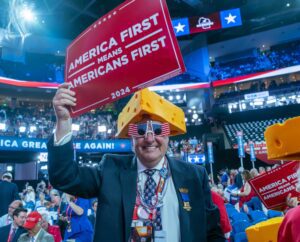
As President Donald Trump readies to travel to China this month, observers are revisiting a year of tariff wars, trade talks, and “America First” signaling across Asia. In the past year, the stated aim of this policy—recasting the United States’ global trade relations to close bilateral deficits and bolster economic security—has driven a raft of negotiations for Agreements on Reciprocal Trade (ARTs) with major partners, most of them in Asia. Most observers are not anticipating a major shift in the U.S. approach to China at this point—China’s leverage remains real. But in any case, other countries in Asia, especially Southeast Asia, have a lot riding on how U.S.-China trade issues are ultimately resolved.
Implementing the “America First” Trade Policy in Asia
To understand why so much of consequence remains in the global and Asian regional balance, it helps to take a look back at the current state of the Trump administration’s trade policy. By the administration’s own lights, the guiding principle of its “America First” trade policy, as announced publicly on January 20, 2025, is to address persistent “imbalances” in U.S. global goods trade, notably the bilateral deficits with key partners, which the Trump administration poses as the source of decades of damage to the U.S. economy. In a formal articulation released on April 2 (“Liberation Day”), the administration framed the challenge as an imbalance that must be corrected not merely through tariffs, but through a broader reconfiguration of market access, investment commitments, and economic security guarantees. What this translates to on the ground, and what it means for Asian economies in particular, is an evolving set of economic arrangements that mix tariff reductions, nontariff measures, and assurances around supply chains, investment, and national security.
05/11/2026 | Joseph Damond | CSIS
Haunted by Tariffs and Trade Wars: A Positive Trade Policy for U.S Agriculture

The Trump administration has deployed tariffs against imports generally—across all types of goods from nearly all US trading partners, in violation of its international commitments. It has done this without consulting Congress, which has the power to regulate commerce under Article I, Section 8 of the US Constitution. Foreign reactions have been generally muted, given broader geopolitical interests of allies, and retaliation has thus far been limited. Nevertheless, there is continuing trade policy uncertainty, resulting in foreign threats of contingent retaliatory responses— often against US agricultural exports—as well as incentives in major markets abroad to diversify sourcing away from the United States in the interest of derisking and implementation of indirect forms of retaliation as US relations with key trading partners continue to fray.
One large source of trade uncertainty is the frequently changing details of the Trump tariffs—on again, off again, rates raised and lowered, product exclusions, bilateral adjustment deals. Another source is the unclear legality of some of his policies.
In Learning Resources v. Trump, Slip Opinion No. 24–1287 (February 20, 2026), the Supreme Court held that President Donald Trump’s tariffs under the International Emergency Economic Powers Act (IEEPA) were unlawful. The president and his top advisors had already made it clear they would impose tariffs under Section 122 of the Trade Act of 1974 as an interim measure. On May 7, the Court of International Trade ruled in State of Oregon v. United States that the Section 122 tariffs went beyond the president’s authority. The statute deals with “large and serious balance-of-payments deficits” that lead to “fundamental international payments problems.” The government has appealed the court’s decision. Regardless, because Section 122 tariffs are limited to 150 days, the administration is also moving to implement a new round of tariffs under Section 301 of the Trade Act of 1974 and, according to some reports, under Section 232 of the Trade Expansion Act of 1962, in place of the president’s Section 122 and IEEPA tariffs. The threat of restoring broad tariffs to replace the reciprocal tariffs remains current and is expected. This could include tariffs at even higher rates than those imposed on April 2, 2025—which the president dubbed “Liberation Day”—(e.g., an increase in the baseline tariffs from 10 to 15 percent) and beyond amounts agreed in various “framework” agreements (e.g., 10 percent for the United Kingdom). These actions raise the risk of heightened trade tensions and retaliatory tariffs by US trading partners.
These tariffs are not the only current threat to trade. The president threatened to cut off trade with Spain completely after it refused to allow use of its airspace in the current Iran war and has threatened to raise US tariffs on European cars from 15 to 25 percent after critical comments by German Chancellor Friedrich Merz of his lack of a clear strategy in the Iran conflict. As Spain and Germany are members of the European Union, the EU Council of Ministers was expected to discuss potential countermeasures against US trade in response. This threat added to tensions arising from the war, which has resulted in a spike in input costs, particularly with respect to energy and fertilizers. This is on top of the increased costs placed on inputs for agricultural production from the Trump tariffs, first under IEEPA, then under Section 122, and planned under Sections 301 and 232.
Read the Full Working Paper Here
05/13/2026 | Warren Maruyama, Joseph W. Glauber, Alan Wm. Wolff & Nicki Ghazarian-Foye | Peterson Institute for International Economics
Defenders of the Jones Act Have Lost

For more than a century, the Jones Act has survived on purported economic and security grounds. Its waiver by the Trump administration for Operation Epic Fury reveals serious flaws in both rationales.
Section 27 of the Merchant Marine Act of 1920, as it’s formally known, requires that goods shipped between US ports travel on vessels that are US-built, US-flagged, US-owned, and crewed predominantly by US citizens. Because of this legally-enforced domestic shipping monopoly, building and operating ships in America today costs far more than doing so abroad, and domestic coastwise shipping is effectively non-existent outside the few places that have no choice, such as Alaska, Hawaii and Puerto Rico.
Rather than bolstering US commercial shipping capacity and the merchant marine, the Jones Act has presided over the steady degradation of both.
Supporters of the law claim it’s essential for national security and has negligible economic costs. They’ve also vigorously opposed waivers of the law, which are permitted in the “interest of national defense,” arguing that exemptions undermine economic and national security and are unnecessary due to sufficient domestic capacity. Their efforts to narrow the waiver conditions have, along with vigorous lobbying, successfully ensured they’re rarely met.
President Donald Trump’s most recent waiver of the law has substantially undermined the pro-Jones Act case. Issued for 60 days on March 17, 2026 – right after the Strait of Hormuz effectively closed – and subsequently extended for another 90, the waiver covers all US territories and more than 659 product categories. That makes it the longest and broadest waiver since 1950. The law also requires that any operator using the waiver file a compliance report on their activities. Here’s what the data thru May 6 show – and what they don’t.
05/07/2026 | Scott Lincicome | CATO Institute
WITA – We put the community in trade community.
Information about upcoming WITA and trade community events
TRADE COMMUNITY EVENTS CALENDAR