


The World Trade Organization (WTO) remains indispensable, underpinning predictability, transparency and the most-favoured nation (MFN) principle across much of global trade. Yet its framework, created nearly 80 years ago, lacks the speed and flexibility to respond to pandemics, geopolitical crises and the weaponisation of economic interdependence — systemic shocks which have become the norm, rather than the exception.
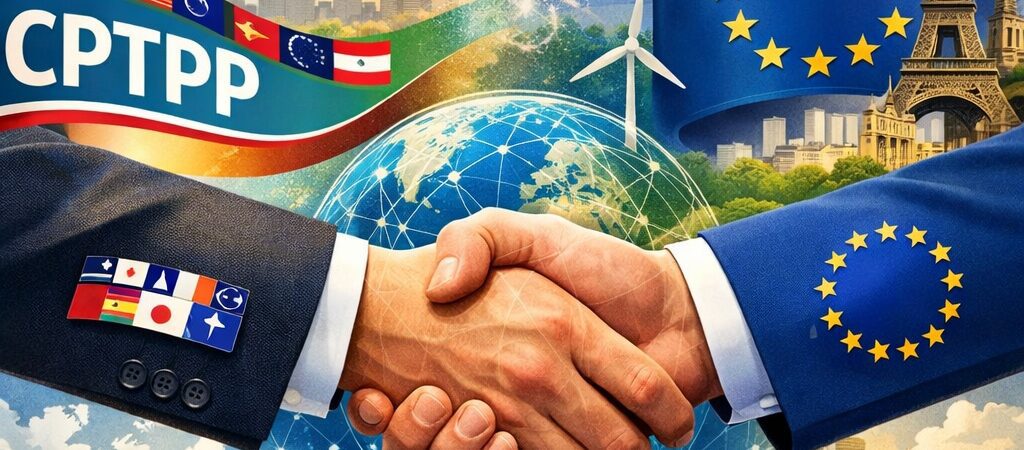
The 14th WTO Ministerial Conference, held in Yaounde in March 2026, again revealed the limits of consensus-based rule-making. The failure to renew the e-commerce moratorium and to incorporate the Investment Facilitation Agreement into the WTO rulebook made this clear. Yet the provisional e-commerce arrangement among 66 members and the second CPTPP–EU joint ministerial statement demonstrated a determination among the willing to advance plurilateral rule-making through complementary channels without rejecting the WTO wholesale.
The causes of WTO stagnation are many, but the difficulty of rule-making resembles a classic collective action problem. The benefits of MFN-based rule-making tend to be broadly and thinly distributed, creating incentives for members to free-ride, while the additional political and economic adjustment costs of liberalisation, regulatory change and reduced domestic policy flexibility are more likely to be concentrated in particular countries and sectors. With many members, each with diverse interests, the coordination costs of consensus-based decision-making are higher, making WTO-wide agreement harder to reach.
One way to ease this collective action problem is to let the countries that are willing to bear the domestic adjustment costs of introducing new rules design and test them first. First-mover benefits such as influence over rule-making and regulatory connectivity can help offset some of these domestic political and economic costs. CPTPP members and the European Union face common challenges — economic coercion by major powers and stalled WTO processes — that give them strong incentives to advance rule-making through practical cooperation.
The legal answer to whether rule-making by willing coalitions stands in tension with an MFN-based WTO depends on context. But developing new plurilateral rules in areas where no WTO consensus yet exists is much different from violating existing commitments.
The difficulty of producing MFN-based agreements under consensus has long presented a challenge to further WTO liberalisation and rule-making. The proliferation of free trade and plurilateral agreements since the 1990s has not been the cause of WTO stagnation, but rather a response to it. The question is how to turn new plurilateral rule-making demanded by today’s challenges into a driver of WTO reform without undermining the existing multilateral trading order.
That is why the strategic value of CPTPP–EU cooperation should not be judged solely by whether the European Union formally accedes to the CPTPP, or whether the two sides negotiate an agreement involving tariff elimination. The European Union already has trade agreements with many CPTPP members, but achieving the kind of flexible supply chains across the two frameworks that industry wants still requires difficult negotiations on rules of origin, including cumulation.
While deeper economic integration is worth pursuing, the realistic starting point is to build upon existing EU agreements with individual CPTPP members, align and update rules that address priority issues and develop necessary cooperation mechanisms. With EU and CPTPP members accounting for about 37 per cent of global trade, cooperation can help spur rule-making within and outside the WTO.
Cooperation should first tackle the low-hanging fruit. Digital trade can build on areas covered by the provisional e-commerce arrangement while updating existing rules against unjustified data localisation requirements and forced source-code disclosure, as well as developing minimum common principles on government access and artificial intelligence governance where agreement is possible. On market-distorting practices, which are already under discussion within the CPTPP framework, priorities could include addressing overcapacity and developing advanced disciplines on subsidies and state-owned enterprises. Drawing on the IPEF Supply Chain Agreement, supply-chain cooperation should begin with early warning, information sharing and emergency cooperation during disruptions, including those linked to economic coercion. Even on rules of origin, work can begin incrementally with cumulation rules for agreed products or sectors.
Some areas of CPTPP–EU cooperation may not be well suited to unconditional multilateralisation. Deeper economic security cooperation involving sensitive information like cybersecurity or critical goods stocks may require trust to be built through credibility. Still, CPTPP–EU cooperation should not be used to punish outsiders, nor should economic security become a cover for disguised protectionism. Genuine economic security measures should be proportionate to the risks, transparent and practically enforceable.
Outside these sensitive areas, CPTPP–EU rules and cooperation mechanisms can evolve and spread through constructive institutional competition with other regional frameworks, CPTPP accession and issue-specific plurilateral arrangements within the WTO. The inaugural CPTPP–ASEAN Trade and Investment Dialogue, launched in November 2025 alongside the CPTPP–EU dialogue, offers one example for how linkages can be gradually built to widen workable rules through multiple, open pathways. To preserve speed, CPTPP-EU cooperation should also use soft-law instruments such as MoUs, action plans and joint principles where appropriate, rather than relying only on legally binding agreements that may require lengthy domestic ratification.
Middle powers should not merely absorb the consequences of great-power coercion. They must engage in proactive economic diplomacy to reduce the costs that major-power behaviour imposes on the trading order and to promote WTO reform. Japan and Australia are illustrative examples of this middle-power role, with experience in rule-making beyond the WTO — from contributing to APEC’s formation in 1989 to preserving the CPTPP after US withdrawal in 2017 and engaging in the Indo-Pacific Economic Framework Supply Chain Agreement in 2024 after the pandemic exposed supply-chain vulnerabilities.
CPTPP–EU cooperation alone cannot save the trading order. But countries that value openness and multilateralism can still lead the formation of next-generation trade rules. To defend the WTO, its supporters can no longer rely on the WTO alone.
To read the full article as it was published by the East Asia Forum, please click here.