



WITA’s Friday Exchange – Tariff & Trade Deja Vu: The New Tariff Regime that’s Coming Seems A Lot Like the Old One
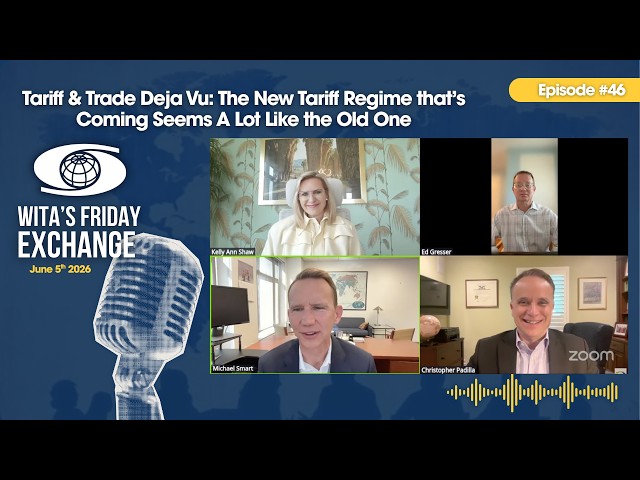
On this week’s episode of WITA’s Friday Exchange, our trade insiders debate the the administration’s Section 301 announcements on forced labor and the coming announcements on over capacity; and whether the Section 301 investigations and expected tariffs are a legitimate and durable trade policy tool or simply a pretext to recreate the IEEPA tariffs and extract leverage from trading partners. They also discussed the future of USMCA, and negotiations with Canada and Mexico to extend the agreement. And lurking behind everything: China.
Featured Speakers:
Introduction: Kenneth Levinson, CEO, WITA – The International Trade Association
Ed Gresser, Vice President & Director for Trade & Global Markets, Progressive Policy Institute; former Assistant U.S. Trade Representative for Trade Policy and Economics – author of the Trade Fact of the Week
Chris Padilla, Senior Advisor, Brunswick Group; former Under Secretary of Commerce for International Trade
Kelly Ann Shaw, Partner, Akin; former Deputy Assistant to the President for International Economic Affairs & Deputy Director, National Economic Council
Moderator: Michael Smart, Managing Director, Rock Creek Global Advisors; former Director for International Trade and Investment, National Security Council, The White House; former Trade Counsel, Democratic Staff, U.S. Senate Committee on Finance
Watch the Video on YouTube | Listen on Spotify or Apple Podcasts
Recorded at 9:00 AM US/ET on 06/05/2026 | WITA – The International Trade Association
Economics for the Real Economy

Ambassador Jamieson Greer is the United States Trade Representative. He wrote this article for the International Monetary Fund’s F&D Magazine.
For roughly 30 years, tariffs and import regulation were policy pariahs. To paraphrase English writer G.K. Chesterton’s quip about Christianity: Tariffs were not tried and found wanting but rejected by au courant economic models and left untried. Policymakers, scared of challenging the elite consensus derived from such models, closed off the universe of options and strategies to solve America’s challenges. But President Donald Trump has changed that and, in doing so, given a gift to economists. The return of tariffs and import regulations creates an opportunity to update old assumptions and dated models with the hard evidence of real-world data and experience.
It is interesting that these policies ever became off-limits. The architects of the post–World War II international economic system knew the risks of unrestricted trade, such as significant trade imbalances or dangerous import dependencies. These architects prioritized national sovereignty and security as equal goals alongside broad-based prosperity. The General Agreement on Tariffs and Trade was deliberately negotiated to allow robust use of tariffs to ensure essential security, prevent damage to domestic industries, respond to unfair competition, foster economic development, and address balance of payments challenges. The Coordinating Committee for Multilateral Export Controls aligned export control policies across the United States and its allies to present a common economic front against the Soviet Union and its satellites. Plurilateral agreements, such as the International Tin Agreement, actively managed trade in key commodities to safeguard supply chains.
By the 1990s, policymakers, economists, and business leaders had forgotten the nuances and pragmatism of their forebears—failing to realize that there are good reasons for preserving countries’ ability to manage their trade relations according to national interests. In the heady days following the fall of the Berlin Wall, there was a rush to adopt the simplicity of hyperglobalization: Would it not be better for all the people of the world to eliminate barriers to trade all together? And so were born the World Trade Organization, the North American Free Trade Agreement (NAFTA), and our present predicament.
05/29/2026 | Ambassador Jamieson Greer | International Monetary Fund
How Trump Supercharged the EU’s Tech Independence Push
BRUSSELS — Donald Trump may have finally done what years of warnings from Paris and Brussels could not: Convince Europe’s free-market holdouts that relying on American technology is a vulnerability.
With his threats toward Greenland, sanctions against international officials and willingness to weaponize Europe’s dependence on American firms, the U.S. president has broken down the final bits of resistance to a French-led push to promote European tech companies at the expense of American alternatives.
On Wednesday, the European Commission is set to unveil its so-called tech sovereignty package aimed at reducing reliance on foreign firms. While early drafts obtained by POLITICO suggest Brussels will shy away from forcing a clean break with foreign tech, the momentum behind the push for digital independence is now impossible to ignore.
“People have finally realized that there’s nothing that wields more power than technology,” said Sebastiano Toffaletti, secretary-general at European DIGITAL SME Alliance, a lobby group campaigning to boost alternatives to American tech giants.
“It’s not just a commodity,” Toffaletti added. “It is a way to exert power and influence, and therefore Europe must have its own.”
06/01/2026 | Mathieu Pollet | Politico
A Middle Power Agenda for the Global Trading System
Middle powers can — and likely will — maintain and improve the rules-based trading system. The question is how they should seek to do so.
The right path is to uphold the principles of non-discrimination and openness that have guided the postwar trading system since its creation. This is the path that will allow the greatest policy certainty, provide scope for cooperation on the widest range of issues and avert a descent into two closed economic blocs.
Those principles were a foundation for the postwar trading system not to achieve untrammelled free trade, but to reflect a wartime conviction that economic exclusion would endanger any lasting peace. The Atlantic Charter of 1941 and allied mutual assistance agreements echoed the understanding that without non-discriminatory access to trade and raw materials, global security would remain at risk. Non-discrimination was necessary to turn a patchwork of plurilateral bargains into a public good.
Compared to the interwar and Cold War periods, today’s global economy is much more interdependent. Decades of liberalisation have given rise to complex global value chains. Connector countries — those that do not obviously side with either the United States or China — help prevent the extremely costly economic bifurcation that could otherwise occur under such intense geopolitical pressure. The United States and China have reduced their bilateral trade but reducing their interdependence is, thankfully, a much tougher ask.
05/26/2026 | Sam Hardwick | East Asia Forum
Trade Law and the Coordination of Security-Based Trade Measures
For much of the postwar period, international trade law treated national security as a necessary anomaly. The rules-based trading system, established through the 1947 General Agreement on Tariffs and Trade (GATT) and later the World Trade Organization (WTO), was built around predictability. It was a reflection of the convulsion of the interwar period, during which the relatively free trade of the prewar period was supplanted by rampant protectionism and economic fragmentation. The GATT framework sought to discipline trade unilateralism by embedding commitments to non-discrimination and tariff binding within a rules-based system. Tariff commitments (Article II), non-discrimination rules (Article I and III), and dispute settlement procedures (Article XXIII) were designed to discipline unilateral action. National security sat uneasily within that framework and was accommodated through an exception. Article XXI of the GATT permits states to take measures they consider necessary to protect their essential security interests and was widely understood to be used sparingly, in exceptional circumstances.
That understanding no longer holds. Over the past decade, and especially since 2022, NATO members increasingly rely on trade restrictions, subsidies, sanctions, and export controls to pursue economic security objectives that are neither temporary nor peripheral. Measures framed as responses to crises, including sanctions following Russia’s invasion of Ukraine and controls on sensitive technologies, have become part of longer-term strategies to manage dependency and shape the strategic environment. Economic security has increasingly moved toward the centre of trade governance, and the national security exception has followed with it, reflecting a broader shift in how states use trade instruments to pursue strategic objectives. This places pressure on the balance between predictability and discretion within trade law. Trade rules are meant to constrain discretion, while security policy depends on flexibility. That tension is now being worked out within the international legal system.
05/31/2026 | Hassan Ahmed | NATO Association of Canada
WITA – We put the community in trade community.
Information about upcoming WITA and trade community events