

WITA’s Friday Exchange: Leverage vs. Certainty: The: “Steel”ing of America, USMCA, 301s, and Article I Powers

In this week’s episode, our trade insiders debate the wisdom and economics of the President’s tariff vision in the context of the USMCA review process. With the upcoming trilateral meetings on July 1, anything and everything in the USMCA review is up for debate. Our former negotiators discuss rules of origin, the impact of the cost of steel and aluminum on U.S. auto manufacturing, and the seemingly inexorable march toward a North American trade fortress. The insiders also cover the summer of the 301s, USTR’s half-deals with various countries, and the China question hanging over the auto industry. They also discussed whether Congress will ever reassert its power over trade policy, and how businesses are functioning amidst trade uncertainty.
Featured Speakers:
Kate Kalutkiewicz, Senior Managing Director, McLarty Associates
Chris Padilla, Senior Advisor, Brunswick Group; former Under Secretary of Commerce for International Trade
Stephen Vaughn, Partner, International Trade, King & Spalding LLP; former General Counsel, Office of the United States Trade Representative under first Trump Administration
Moderator: Arun Venkataraman, Partner, Covington & Burling LLP; former Assistant Secretary of Commerce and Director General of the U.S. and Foreign Commercial Service, U.S. Department of Commerce
Watch the Video on YouTube | Listen on Spotify or Apple Podcasts
Recorded at 9:00 AM US/ET on 06/26/2026 | WITA – The International Trade Association
Trade at the Border: Customs, Enforcement, and Emerging Challenges
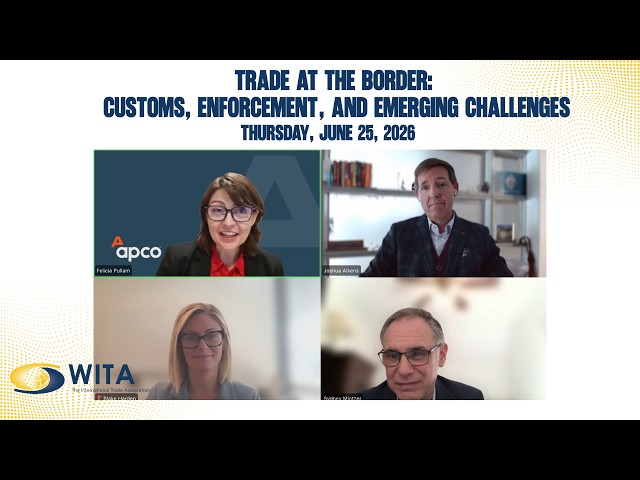
As governments increasingly rely on tariffs, customs measures, and regulatory tools for economic and national security goals, viewers joined our WITA webinar for a 10,000-foot view of the shifting customs landscape. This included the Administration’s recent customs Executive Order and the broader shift from compliance toward enforcement and implementation.
Our speakers unpacked evolving agency roles and new border requirements, examining these issues within a broader global context. The discussion explored what these shifts mean for companies navigating increasingly complex supply chains, rising enforcement priorities, and emerging updates shaping near-term compliance and border requirements.
Featured Speakers:
Joshua Aikens, Head of Government Affairs, Zonos
Blake Harden, Managing Director, Washington Council Ernst & Young; former Trade Counsel on the House Ways & Means Committee; and former Senior Attorney in the Office of the Chief Counsel at US Customs and Border Protection
Sydney Mintzer, Partner, Customs, International Trade, Supply Chain & Distribution, Mayer Brown LLP
Moderator: Felicia Pullam, Senior Director, Geo-Commerce, APCO Worldwide; former Executive Director, Office of Trade Relations, U.S. Customs and Border Protection
06/25/2026 | WITA – The International Trade Association
The World Trade Organization After Trump
ABSTRACT
The Trump Administration’s imposition of steep and discriminatory tariffs on much of the world with which the United States trades is often seen as a fundamental attack on the World Trade Organization (WTO), which may not survive unless extreme measures are taken, such as the removal (or voluntary withdrawal) of the United States from the WTO. This article questions this narrative, arguing that there are strong reasons to believe that the WTO has the resilience to survive and evolve despite the tension between the transactional power politics of trade and the values of legalism and non-discrimination that are emblematic of the multilateral trading system embedded in the WTO. A historical perspective reveals that the multilateral trading system has always been confronted with gaps between the ideology and ideals surrounding trade multilateralism and, on the other hand, the reality of the system, where rules and their enforcement are shaped by power and where non-discrimination is often honored in the breach. The system has adapted and accommodated to power politics. Proposals to remove the United States from the WTO would themselves constitute violations of international law, as the WTO constitution or charter does not contain any provision for expulsion of a WTO Member, much less any objective criteria for so doing. In recent years, the WTO has pivoted to new roles and agendas—generally under the rubric of inclusive trade—that deviate from the rule creation and enforcement through dispute settlement focus that many observers still see as the entire basis for the WTO’s existence. It is more equipped to withstand the current trade winds and to ride the waves than is appreciated by those with nostalgia for days when the WTO was widely seen as the poster child for neoliberal globalism in a neoliberal era, as well as for the post-Cold War liberal narrative of the global rule of law.
I. INTRODUCTION
Can the WTO withstand the Trump tariff shock, or is some kind of radical action needed if there is still to be a meaningful multilateral trading system? Even before the tariff shock of the last months, the WTO was frequently criticized as moribund or paralyzed. But the Trump approach to tariffs seems a complete antithesis to the values and ideals underlying the WTO rule of law, nondiscrimination, predictability, certainty, and transparency in the regulation of trade. Paulsen and Ciuriak state the stark opposition between “rules-based governance” and Trump’s “exercising coercive power and weaponizing the networked global economy for geopolitical and domestic economic objectives.” Baldwin warns: “The global implications are stark. By violating key World Trade Organization principles like non-discrimination and tariff bindings, Trump’s tariffs risk cascading protectionism worldwide.”
Multilateral economic governance has, however, taken significant shocks in the past and lived to see another day. In the 1950s, the United States threatened to leave the General Agreement on Tariffs and Trade treaty (GATT) (the multilateral trade institution that morphed into the WTO in 1995) unless its member states found a way of accepting domestic U.S. agricultural policies despite their clash with GATT rules. In 1971, Richard Nixon unilaterally destroyed the gold standard as the anchor for international monetary relations—creating a revolution in global finance, and at the same time imposing an extra ten percent across-theboard tariff on imports. The IMF and the GATT survived. Based on past crises, one should not underestimate the potential resilience of the WTO.
Read the Full Research Paper Here
06/25/2026 | Robert Howse | University of Arizona
Workers’ Empowerment as U.S. Trade Policy

ABSTRACT
U.S. trade policy stands at a critical inflection point. While the Biden administration’s “workercentered” approach and the Trump administration’s “America First” platform sharply diverge, both recognize that trade deeply impacts domestic employment. However, both policies overlook how the treatment and costs of labor in partner nations directly protect U.S. workers from unfair competition. This Article argues that empowering foreign trade-sector workers to secure higher wages and better conditions must become a central pillar of U.S. trade policy. Drawing on an original empirical study of Mexico’s automotive sector under the United States-Mexico Canada Agreement (USMCA), I demonstrate that recent “worker-centered” efforts failed to truly empower foreign labor. Instead, they left workers vulnerable, incentivized corporate offshoring, and suppressed foreign consumer power—deficiencies that ultimately harmed domestic workers and fueled protectionist, tariff-driven alternatives. By uncovering the direct link between foreign supply-chain capacity and U.S. job opportunities, this Article challenges conventional narratives surrounding trade agreements and foreign aid. Ultimately, it underscores the urgent need to radically reconceptualize U.S. trade policy to protect the global workers who make trade possible.
INTRODUCTION
For many decades, we’ve enriched foreign industry at the expense of American industry . . . One by one, the factories shuttered and left our shores, with not even a thought about the millions upon millions of American workers left behind. The wealth of our middle class has been ripped from their homes and then redistributed across the entire world. — President Trump
In January 2025, the Trump administration announced an abrupt departure from the Biden administration’s U.S. trade policy. Pronouncing that it’s time to put “America First,” President Trump canceled the former administration’s aid and assistance to empower workers in trade. President Biden’s approach had assumed that helping workers abroad would disincentivize a race to the bottom, consequently helping workers in the United States. President Trump capitalized on Biden’s failure to accomplish that objective, announcing in its place a slate of high tariffs promised to “strengthen the international economic position of the United States and protect American workers.” Although Biden and Trump’s approaches appear to diverge, they share a core belief that U.S. trade policy should improve opportunities and conditions for workers in the United States. However, neither approach has succeeded in protecting workers in the United States from the deleterious effects of cheap labor in competitor countries.
This Article is about the relationship between U.S. trade policy, the empowerment of foreign workers, and the treatment of workers in the United States. My claim is that workers’ empowerment throughout the trade sector, when executed correctly, is necessary if U.S. trade policy hopes to preserve high wages and decent working conditions at home. In that sense, worker protection is neither a domestic nor international issue; rather, it is a structural feature of fair competition. Conceptualizing empowerment as a pillar of U.S. trade policy will help mitigate the perverse incentives in liberalized trade that prioritize short-term profits over productivity, efficiency, and global demand.
Read the Full Research Paper Here
06/10/2026 | Desirée LeClercq | University of Georgia School of Law
Dealing with Defence: Canada’s Use of Economic Agreements as Instruments for Security
On March 6, 2026, Prime Minister Mark Carney stood beside Japanese Prime Minister Takaichi Sanae in Tokyo and signed a Comprehensive Strategic Partnership. Take just a glance at the press release and it is easy to see just how “comprehensive” it is; the agreement makes mention of everything from joint naval operations, to increasing clean energy cooperation and lowering carbon emissions, to expanding commercial and investment opportunities. A few years ago, each issue would have required separate negotiations and produced separate agreements, but in 2026 they’re all collaborated on at once — a testament to the new reality that Canada, and its allies, can no longer meaningfully treat them as separate from each other.
Earlier this month, Kaya Dupuis argued that Carney’s Davos speech exposed a gap in NATO’s mandate: Article 5 was not designed to protect allies from non-military threats. As economic integration and globalization have become integral for allies and adversaries alike over the past eighty years, what constitutes a threatening or coercive act has become harder to define. A tariff regime is not an act of war, a supply-chain cut-off is not an invasion, and aggressive use of investment screening, export controls, sanctions, or discriminatory procurement can all be defended as industrial policy, even when they are coercive. For instance, when Lithuania let a “Taiwan Representative Office” open in Vilnius in 2021, China did not threaten force. Instead, it quietly erased Lithuania from its customs system so that goods could no longer be cleared, rejected Lithuanian import paperwork, and banned products like beef and dairy on apparent sanitary grounds — leading the total value of exports to China to collapse almost entirely within a month.
This gap has not gone unnoticed within the Alliance, with former NATO Secretary-General Anders Fogh Rasmussen even calling for a new “Economic Article 5” to cover what the original treaty did not anticipate. In the meantime, NATO member states have developed their own responses. Canada’s answer has been to increasingly blur the line between economic and defence policy, and is using trade agreements as instruments for security.
Trade Doing Defence Work
Canada’s nascent strategy is to address economic threats with economic defence. In the nine years before Carney became Prime Minister, Canada concluded roughly three formal Comprehensive Strategic Partnerships or equivalent frameworks — with the European Union in 2016, South Korea in 2022, and ASEAN in 2023 — at an average of one every three years. In Carney’s first year in office, Canada has signed or elevated at least twenty economic and security deals over the last year. In each, Canada is aiming to build reciprocal supply-chain dependence, since a partner who needs what you produce is a partner with whom coercion is mutually costly.
06/24/2026 | Tyler Stevenson | NATO Association of Canada