


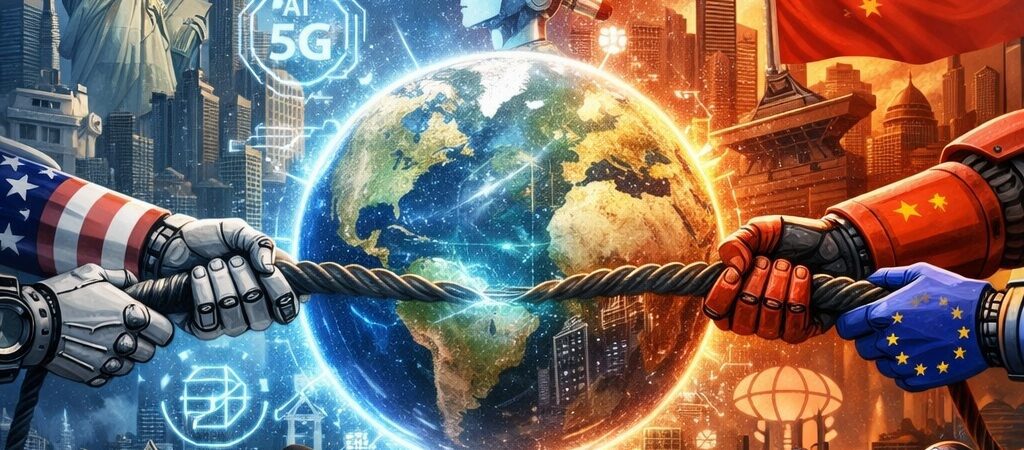
Trade is not neutral. It has always reflected national interests, and what comes next in the global trade architecture should reflect the geopolitical moment. The post-Second World War globalization first took shape among Western-bloc countries during the Cold War and sharply accelerated after the fall of the Soviet regime. Those two phases were, to a great extent, models tailored for geopolitical purposes — first to compete with the Soviet Union, later to reflect the United States’ “unipolar moment.” The rise of China changed this trajectory, and now the global trade system is drifting into the unknown. This article proposes and explains a feasible way of thinking about trade deals during the 21st-century Great Power competition: incorporating the notion of strategic techno-economic agreements.
It is clear that the Trump administration challenges the current alliance architecture. It has imposed tariffs on friends and foes alike — some even higher than those on China. It has ignored, dismantled, and destabilized even the most longstanding of its international commitments. Yet, two things are certain. First, there are voices within the Trump coalition recognizing the need for a collective, allied approach to Great Power competition. Second, America’s political cycles fluctuate; China’s subversion, variously subtle and overt, of the global trade system stems from a fundamental goal of global dominance in advanced-technology industries.
Why free trade agreements fall short
A global trade architecture that aims to progressively reduce trade barriers — an idea the authors generally support — functions as a prisoner’s dilemma. Trade barrier reductions work if all countries are on board with this project; China, while it has opened its economy compared to before its World Trade Organization (WTO) accession, has selectively limited market access in strategic sectors.
This highlights another issue: free trade agreements were built on the general idea that all economic sectors are equal. This is particularly problematic when the largest economy, China, does not fully adhere to WTO commitments and is consolidating its position as the “factory of the world.” Treating all economic sectors equally for trade priorities omits the supply chain dependencies, the embedded knowledge within production systems, the rising value of services within traded merchandise, and ultimately the intertwined relationship between manufacturing and geopolitics and defense capabilities. This has become increasingly evident over the past five years with the pandemic, the deployment of supply chain chokepoints, and Russia’s ability to sustain its invasion of Ukraine with various forms of support from Beijing.
China’s accession to the WTO and its subsequent failure to fulfil its access commitments formed the basis of America’s radical departure from its earlier push for free trade, but there are other reasons, including US trade policy’s blindness to the harm that foreign countries might inflict on its strategic industries, the US’ failure to transition to specializing in high-value goods and services, and other countries enactment of non-tariff barriers (NTBs) in the post-Cold War period.
In this context, we propose an alternative to free trade agreements that acknowledges geopolitical priorities while keeping zero-for-zero tariff reductions and the reduction of trade barriers as feasible goals.
Strategic Techno-Economic Agreements as an alternative to FTAs
Strategic Techno-Economic Agreements (STEAs) should be a unified, binding set of provisions that secure America’s and its partners’ global leadership in advanced-technology industries. STEAs go beyond trade facilitation — which is one of their components — and should encompass specific chapters covering the development of what our work in Information Technology and Innovation Foundation (ITIF) defines as “national power industries”: advanced, traded-sector industries that form the foundation of military strength, economic resilience, and strategic independence, and the protection of proprietary technologies from access by rivals. STEAs should be built on two pillars, each supporting the others.
Provisions in the first pillar, “Advance allies’ economic development of strategic industries,” may include:
Digital economy integration: The STEA should be the world’s template for digital trade rules, with modern, binding provisions that enable digital market integration, foster a competitive environment, and improve the user experience. The key provisions that are present in the US-Mexico-Canada (USMCA) digital trade chapter and in the e-commerce chapter of CPTPP could be the basis, but the STEA should go beyond to include binding provisions banning digital service taxes (DSTs).
Collaboration in advanced technology industries: China’s panoply of support measures for its advanced industries is so extensive that it will be hard for any one country to respond effectively. What is needed is much more cooperation among allies. This will entail joint initiatives to articulate and streamline technology partnerships for strategic industries, such as quantum, semiconductors, nuclear fusion, and biotechnology, and to align aid and development funding for third parties to gain market share in these sectors.
High-skilled talent movement: Parties should agree to facilitate visas for highly qualified students and professionals, particularly those with science, technology, engineering, and mathematics (STEM) degrees and/or working in strategic, advanced-technology industries. This would require the US to reverse increasingly higher impediments to H-1B visas and for future administrations to change the nation’s thinking on and approach to immigration policy radically.
Provisions in the second pillar, “Limiting the outreach of China’s non-market system,” may include:
Immediate reciprocity: Parties should have a reciprocal approach to addressing the extensive NTBs and other technical barriers to trade that China has erected to impede US and allied companies’ ability to compete in China. This means mirroring the restrictions that China imposes on Chinese companies in its market. For example, if China threatened to place a country’s firms on its “Unreliable Entity List,” the participating nations could agree to limit imports from Chinese firms that compete with the listed company.
Coordinated import ban on fraudulent goods: Parties should take measures to prevent companies with a sustained record of intellectual property (IP) infringements from entering their markets. This would mean, in practice, banning imports from IP-infringing companies in all countries that are signatories to the STEA. According to the Office of the US Trade Representative, China remains the world’s most significant practitioner of IP theft, content piracy, and the export of counterfeit goods.
Sharing commercial counterintelligence: Western advanced-technology companies are often targeted by foreign intelligence services seeking to obtain valuable knowledge and other IP surreptitiously. Counterintelligence within a STEA economic bloc should, among other tasks, help companies gain more complete information about the environment in which they operate so they can more effectively reduce information loss to competitors.
Conclusion
The idea of a STEA is a realistic, yet challenging, proposal. For a STEA to work, the US would need to recalibrate its trade policy to center on the techno-economic competition with China. This means reversing or changing some policies and approaches that treat allies and trade partners in the same category as China. For US partners, the first steps should be to acknowledge trade irritants with the United States and to take measures to address them, for example by eliminating or significantly reduce NTBs that are considered discriminatory against US companies, such as DSTs.
The global trade system will not be the same as it was before April 2025, when the US imposed unilateral tariffs on friends and foes alike. However, the system had already started to come apart well before then. A truly pragmatic and sustainable trade alliance will only be feasible if it addresses the root causes of the failure of the once-existing free-trade era.
To read the full report as it was published by the Hinrich Foundation, please click here.