


Richard Baldwin is a Professor of International Economics at The International Institute for Management Development (IMD).
Introduction.
In April 2025, President Trump put tariffs on almost everything from almost everywhere. This was the first full-power test of his norm-shattering tariff strategy. The test failed.
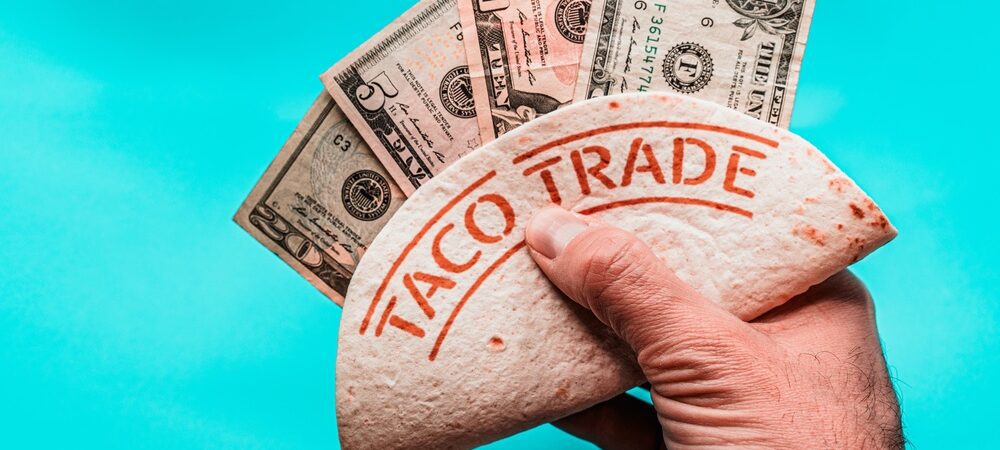
Grievance-fueled tariffs collided with financial market reality, and reality won. A week after putting them up, the President took them down. He TACO’d, dialling down the tariffs to 10% for most nations. I call it the financial market TACO in my recent eBook, World War Trade.
But the financial market TACO did not produce tariff peace.
Trump continued to escalate his tariff war with China.
First, he put 34% on China. China retaliated with 34%. Trump raised it to 84%. China matched. US tariffs went up to 125%. China matched.
Tariffs at these extreme levels meant that the US and China “have declared a trade embargo on each other, normally an act of war,” as Guardian columnist George Magnus wrote on 14 April 2025.
Hubris invites nemesis.
In April 2025, Donald Trump seemed confident that he held the upper hand in this escalation loop. The arithmetic seemed obvious. China exported far more to the USA than the USA exported to China. With tariffs at embargo-like levels, Chinese factories would feel the pain first. Beijing would blink. That was the theory.
But by May, Washington’s theory collided with US industrial reality, and reality won.
The reality arrived in Los Angeles.
A container ship voyage from China takes a few weeks. Ships already at sea kept arriving. Until they didn’t. In early May, the Port of Los Angeles, America’s main gateway for Chinese imports, faced a sharp drop in inbound volume. Longshoremen couldn’t get work.
In April, Donald Trump thought he was squeezing Chinese factories. And he was. In May, he discovered he was also squeezing American workers and factories.
In the American heartland, US tariffs were leading to slowdowns and shutdowns of US production lines. CEOs of the biggest American retailers warned that the tariffs could trigger product shortages and price spikes at Walmart, Target and The Home Depot. “Starting in a couple of weeks, we are just going to start running out of stuff,” said Sean Stein of the US-China Business Council, “and if the administration waits until we have shortages and hoarding, that is just too late.”
The simple fact was that US manufacturing supply chains were deeply dependent on Chinese inputs. China had a chokehold on US trade policy. But it wasn’t China doing the choking. It was USA choking itself with extreme tariffs that stressed US factories and emptied American shelves.
For Americans, the choking wasn’t abstract. It showed up as higher prices at the checkout counters and online stores. Worse yet for Donald Trump, the damage hit his political base especially hard.
Trade wars, it turned out, were not “good” when they emptied shelves and shut down your own factories. They were not “easy” when your supply chains relied on imports from your opponent.
But reality is hard to see when you don’t want to see it.
The Geneva US-China talks.
For weeks, Washington acted as if time was on its side. It was a strange thing to watch.
President Trump claimed that China was desperate and suing for peace; he said that President Xi Jinping had called him; Beijing denied it. Scott Bessent said China was pushing for negotiations; Beijing denied it.
The two nations were in a “you-ask-first” staring contest.
On 9 May, President Trump blinked. He announced on social media that the USA would cut tariffs on China to around 80%. The White House spun it as the “Art of the Deal.”
It was an extraordinary move. In most trade wars, tariff reductions come at the end of negotiations. This one came as the entrance ticket to talks. The unilateral offer gave President Xi the face-save he needed to agree to talks. They happened in Geneva.
After just two days of negotiation, the two sides agreed to shift from 125% to 10%. For the US, this was, net of retaliation and counterretaliation, a reduction from the 34% Liberation Day tariffs. For China, it was an increase of 10%.
The US tariffs were down. The Chinese tariffs were up. In my book, I call this the China TACO.
Headlines of “US caves to China” would not have been a good look for President Trump. To avoid them, Treasury Secretary Scott Bessent did in May what he had done in the face of the financial market TACO. He made the withdrawal look like a win by recasting history.
In his announcements to the media, Bessent added in the 20% tariffs that Trump had imposed on China back in February and March—before the April escalation loop. China had retaliated against those at the time, but the White House left that out of the calculation.
Thus the history recast was to claim the US went from 145% to 30%, while China went from 125% to 10%.
Much of the US media reported Bessent’s history-recast as fact. The New York Times, which fell for the spin, inadvertently illustrated Bessent’s sleight of hand. In a timeline graphic tracing the tariffs’ ups and downs from February to May, it showed that both sides imposed 20% before the Rose Garden announcement. Yet on Rose-Garden-day, the Times reset China to zero, but kept the US tariff at 20%.
Whether this was confusion or convenience is unclear, but in the panel tracking US tariffs, the pre-April 20% was added to the April 125%, making it 145%. The panel tracking Chinese tariffs did not, leaving it at 125%. Going into Geneva, the Times claimed, it was 145% vs 125%. Not 125% vs 125%.
When both lowered their tariffs by 115% in Geneva, the Times’s arithmetic scored it as 30% vs 10%. The spin was dialled in when Beijing did not publicly challenge the American arithmetic.
Much of the media repeated it. The impression took hold that Washington had won a tough fight on points.
One prominent publication pointed out Bessent’s recasting of history. The WSJ wrote: “Beijing called Mr. Trump’s bluff with hefty retaliatory tariffs … The result has been a scramble by Mr. Trump to sue for trade peace without any behaviour change from China.”
Secretary Bessent’s spin was a masterclass in the fine art of Trumpian “retreat and recast.” To many observers, the May announcement seemed to tame the Rose Garden tariffs while leaving America in control. It did not.
But beneath the spin, something fundamental about World War Trade had been decided.
The full-power test of Trumpian tariffs had produced its first lesson. China had escalation dominance on tariffs. China could withstand tariff pain longer than the USA.
The April to May tariff duel showed that Washington had misjudged where the tariff pain would land hardest. It had also misjudged something even more consequential, but that didn’t become apparent until later.
Don’t bring tariffs to an export control fight.
Washington had entered its confrontation with China believing it would be a tariff battle. China answered in kind: you want a tariff war? Fine, we can do a tariff war. But once the embargo-like tariffs began to choke American factories, the two sides met in Geneva and tariffs came down.
Yet the Geneva Joint Statement did not touch the other trade weapon China brought to the US-China trade battle: export controls.
As May turned to June, US manufacturers began complaining of shortages and uncertainty in Chinese supplies of rare-earth magnets. There were no headline-grabbing events, just a growing number of American factory managers discovering that critical inputs were not arriving on schedule.
The Geneva deal was a tariff ceasefire, but the export control battle was just getting going.
Rare-earth magnets are tiny components with outsized importance. They are financially trivial, so China loses little by cutting off exports. But they are technically indispensable. Any good that involves moving things with extreme precision needs them. They are the heart of miniaturised, high-performance electric motors embedded in cars, cameras, drones, industrial robots, wind turbines, and smartphones.
The defence implications are even more striking. Rare earth permanent magnets are indispensable for US military power. Radar systems, fighter jets, battleships and nuclear submarines cannot be made without them. In precision weapons, they control the fins that adjust flight paths in milliseconds. Alternatives exist, but in practice, there are few workable substitutes.
In the film Dune, the “spice melange” looked like dust, but nothing moved without it. Rare-earth magnets are today’s spice melange. And China controls the world’s supply.
That leverage was not theoretical. In May, Ford shut down production of its Explorer SUV at its Chicago plant for a week because of a rare-earth magnet shortage. By mid-June, Ford’s chief executive Jim Farley admitted: “It’s day to day. We have had to shut down factories.”
Chinese export controls, it turned out, were more effective than US export controls. For years, the USA had restricted China’s access to advanced semiconductors and chip-making equipment. US officials believed they controlled key technological choke points.
But semiconductors have workarounds. They are complex and expensive to replace but substitutes and alternative suppliers exist. Chinese industry had been powering ahead for years despite US restrictions. Rare-earth magnets are different. For many applications, there are no practical substitutes and no alternative suppliers. As one industry executive put it, “It will take 10 to 15 years before a robust supply chain that excludes China can be fully developed.”
That is why Washington had wanted to address the problem in the Geneva talks. US officials came away thinking China had agreed to roll back its export controls as part of the deal. The President publicly declared that it had.
The fine print told a different story. The Joint Statement referred to removing “non-tariff retaliation against the US.” China’s export-control regime was neither retaliation nor US-specific. It was framed as national security policy and applied globally. It fell outside the scope of the Geneva agreement.
Was this oversight due to lack of trade negotiating experience of the US team in Geneva? Was it due to the rushed manner the trade talks were conducted? We may never know why, but the ‘why’ didn’t change the need to redress the remiss.
US-China talks resumed in London in June. The American side arrived thinking they could secure a rollback of China’s export controls. Instead, after three days of meetings, the two sides produced what diplomats produce when they cannot agree on substance: a handshake for a framework.
Donald Trump treated the handshake as if it were a completed deal. “OUR DEAL WITH CHINA IS DONE,” he wrote, promising “FULL MAGNETS” and “A TOTAL OF 55% TARIFFS.” The Chinese readout said nothing of the sort. Export applications, Beijing replied, would be approved “in accordance with the law.”
There was some short-term relief. Reuters reported that temporary export licences were granted to suppliers serving major US automakers. That addressed the pain, not the problem. The shortages were not catastrophic, but they were persistent.
The next problem was that the end of the 90-day tariff suspension was approaching. Neither side wanted a return to April’s chaos. Talks were held in Stockholm that extended the suspension for another 90 days.
But there was no progress on export controls. The text of the Stockholm agreement was largely cut-and-pasted from Geneva. The fine print remained unchanged.
Trump’s final attempt to reverse Chinese export controls came in October at a face-to-face meeting of Presidents Trump and Xi in Busan, Korea. In the weeks before the meeting, both sides escalated. Washington expanded its Entity List. Beijing rolled out broader rare-earth restrictions, including extraterritorial provisions. New port fees were announced; retaliation followed. It was, in effect, a diplomatic pump-and-dump. Escalate before the summit; de-escalate at the summit.
When the leaders met, most of the newly announced measures were withdrawn. Some US semiconductor restrictions were relaxed. China agreed to postpone its hardening of its export permit regime. But the core structure remained unchanged.
One result was astounding. The USA lowered its average tariff on China more than China lowered its tariffs on the USA. The asymmetry was unmistakable. Tariffs came down. Export controls did not. This was a second China TACO.
President Trump moved on.
By year-end, the US-China conflict was a long way from what it had been on that rainy April day in the Rose Garden.
China had demonstrated that it had the upper hand in tariff battles. US tariffs imposed an intolerable burden on American manufacturing given its reliance on Chinese inputs. Chinese exporters found other customers. After May 2025, US tariff rates on China moved only one way: downward.
China’s export controls, by contrast, remained in place. Beijing continued to apply its export controls in measured doses. American manufacturers were still complaining in January 2026. Instead of retaliating, the USA began relaxing some of the Biden-era export restrictions on China.
China had demonstrated that the US did not have escalation dominance when it came to either tariffs or export controls. The US manufacturing sector was dependent on Chinese industrial input, especially rare earth magnets. China could, and did, force Donald Trump to back down. In plain English, America’s reliance on Chinese industrial inputs gave China a stranglehold on US trade policy.
But it didn’t look that way to most Americans. They read happy headlines about President Trump finally standing up to the Chinese.
So what did President Trump do after having met his match? In a now familiar retreat-and-recast move, he changed the subject and moved on.
He intensified his military strikes on small boats in the Caribbean and then pivoted to negotiating trade deals with countries where America had tariff escalation dominance.
Concluding remarks: The Iran codicil
The US-China trade war of 2025 offers lessons for Trump’s 2026 shooting war in Iran.
The USA can escalate in the Gulf. Trump has repeatedly threatened to do so. But each time he climbed down. These flip flops, in the real war in Iran and the trade war with China, had little to do with foreign actions. They were driven by cost-of-living considerations in America. As with his Chinese tariffs, the weapon and tactics he is using in Iran are hurting his political base.
China established escalation dominance by showing it could absorb the export pain caused by US tariffs longer than President Trump could absorb the pain his own tariffs caused his political base.
Shortages, price spikes, and factory disruptions forced a rethink. The response was not framed as retreat. That was his China TACO.
Iran presents a different battlefield, but a similar logic. Like China, it controls a choke point that can impose pain on American consumers and producers, the Strait of Hormuz.
If that pressure feeds through to US prices and jobs, the political arithmetic looks much the same. The incentive to TACO is the same.
The difference is that this time, the optics are harder to manage. In 2025, Beijing was content to allow Donald Trump his happy headlines. When Trump did a climbdown and call it a chest pump, China stayed silent.
Iran and American military and foreign affairs experts do not seem willing to play along with a make-believe victory. Since happy headlines are the heart-and-soul of a Trumpian TACO, I fear we may see more pretend-and-extend rather than a clear TACO. But who knows?
When Trump met his match in China, he declared victory and moved on. If the same dynamics play out with Iran, the ending may look familiar. Find a fig leaf. Declare victory. Pass the problem on to someone else. Move on to the next norm-shattering actions. Cuba? Greenland? Some other island?
To read the full piece as it was published on Substack, please click here.