


WITA’s Friday Exchange: Wink Wink, Nudge Nudge – Plan B Tariffs, Section 301 Investigations & the ARTs of the Deals

No one understands the dynamics with key U.S. trading partners better than the people who led these kinds of difficult trade negotiations for the United States. Panelists will update our viewers on the trade policy announcements, what remains undone; and what are expected next steps in these trade negotiations.
In the latest episode of the Friday Exchange, our trade insiders break down the shifting landscape of U.S. tariff policy and the new Section 301 investigations announced by the Trump Administration. The panel explores whether the administration’s flurry of new Section 301 investigations targeting excess capacity across 16 countries and expanding forced labor concerns represents a strategic “wink wink, nudge nudge” plan B to rebuild the tariff framework and reopen negotiations with trading partners. The conversation also looks at cautious reactions from Asia and Europe, the delicate balance of stabilizing tariffs with China while scrutinizing other partners for unfair trade practices, and how these investigations could serve double as opportunities to refine tariff levels, and shape the next phase of U.S. trade policy ahead of the upcoming U.S.–China summit.
Featured Speakers:
Introduction: Kenneth Levinson, CEO, WITA – The International Trade Membership Association
Wendy Cutler, Senior Vice President, Asia Society Policy Institute; former Acting Deputy U.S. Trade Representative
Peter Harrell, Visiting Scholar, Georgetown Institute for International Economic Law; former Senior Director, International Economics, at the White House under President Biden
Daniel Mullaney, Non-Resident Senior Fellow, Atlantic Council; former Assistant U.S. Trade Representative for Europe and the Middle East
Mark Linscott, Senior Advisor at the Asia Group and the US-India Strategic Partnership Forum; former Assistant USTR for South and Central Asia and before that WTO and Multilateral Affairs
Watch the Video on YouTube | Listen on Spotify or Apple Podcasts
Recorded at 9:00 AM US/ET on 03/13/2026 | WITA
Europe Pushes Back on Trump’s AI Plan

Although President Donald Trump’s AI agenda often centers on domestic priorities like weakening state regulations and building more U.S. data centers, his ambitions have always been global in scale. The world was reminded of this at India’s 2026 AI Impact Summit, where Michael Kratsios, Trump’s chief science and technology advisor, pitched an AI exports program, urging allies to adopt the United States’ full AI tech stack. For many countries, though, the idea of relying solely on American AI infrastructure has raised national security concerns, and strengthened calls for greater “tech sovereignty.”
Tech sovereignty is a country’s ability to control vital technologies by investing in both domestic capabilities and strategic partnerships. However, nations becoming more self-reliant in areas like artificial intelligence could spell trouble for American AI exports, setting up a power struggle with the Trump administration over who gets to develop and deploy the tools that could reshape society for decades to come.
What Does Tech Sovereignty Mean?
Tech sovereignty is difficult to define because it means different things to different nations, Kelsey Quinn, Project Lead and Analyst of Tech Sovereignty and Security at the nonpartisan American think tank New Lines Institute, told Built In. But broadly speaking, it refers to a “country’s ability to independently develop, access and control the technologies that underpin its economy and national security,” she said.
Achieving secure access to AI models, microchips, cloud platforms and other crucial technologies requires a wealth of resources, with “resources” encompassing a country’s financial capital, talent pool, public works and political power. Ideally, a tech-sovereign state should then be able to protect private information with its own data governance measures, build out its own hardware and infrastructure and enforce its own tech regulations — all without relying on anyone else to complete any of these actions.
Of course, the irony is that no nation can achieve true sovereignty within today’s interconnected trade system. Governments use their relations with each other to obtain the minerals, personnel and products needed to enhance their workforces and tech stacks. Tech sovereignty permits these partnerships when they make sense, but it also encourages a country to become resilient to the point where it can act independently in pursuit of its own interests whenever necessary.
Proponents of tech sovereignty want to avoid relying on another nation’s technical capabilities to the point where they become essential to developing their own. Yet few countries have the resources to meet all the criteria of tech sovereignty, sparking urgent conversations among political leaders around what tech sovereignty looks like for their nations and whether it’s even feasible as Trump more aggressively seeks to solidify American AI dominance.
03/11/2026 | Matthew Urwin | Built In
Oil, Power, and The Dollar
Disclaimer: This article was originally published prior to the outbreak of the war with Iran on February 28, 2026 and may not reflect current geopolitical developments.
The authors are with Arci Capital IFSC in GIFT City, India.
When we talk about Iran or Venezuela today, it’s tempting to reduce the story to politics or security headlines. But at the most structural level, these situations are about oil, its role in the global economy, and how that connects to money, markets, and geopolitical power.
Understanding this history helps explain the present. When tensions flare in the Middle East, when sanctions target energy exports, when shipping lanes are threatened, markets react instantly. That reaction is not irrational, it is rooted in a century of precedent. Oil has repeatedly shaped the balance of power, determined strategic alliances, and influenced the architecture of global finance. It remains one of the clearest lenses through which to view the world order.
Oil isn’t just another commodity. For the past half-century, it has been central to global finance and geopolitics, both as a physical source of energy and as a pillar of the world monetary system. Energy has powered not just engines and factories, but the rise and fall of nations.
Why Oil Used to be the Ultimate Lever
After the collapse of the Bretton Woods gold convertibility system in the early 1970s, the United States struck a series of arrangements, most importantly with Saudi Arabia to price oil in US dollars. Because oil was priced in dollars worldwide, countries needed to hold dollars to trade energy. That surplus demand kept the dollar strong, sustained its reserve status, and underpinned American economic influence for decades. The petrodollar was effectively a way for the U.S. to export liquidity and import leverage.
But that system relies on two assumptions:
1. Oil is priced and traded globally in dollars
2. Dominant producers remain aligned with the U.S.
When either of those shifts, the balance of global economic power shifts with it.
03/04/2026 | Rishi Mehta & Raj Mehta | Unpacking the Present on Substack
What The US and EU Trade Deals With India Mean for The WTO
Mark Linscott is a guest on Episode 34 of WITA’s Friday Exchange Podcast this week.
It should go without saying that it has been an eventful year on the tariff and trade front. Even with the US Supreme Court’s decision on February 20 striking down “reciprocal” tariffs under the International Emergency Economic Powers Act (IEEPA), US tariffs are at levels not seen since the 1930s. Countries from El Salvador and Guatemala in Central America to Uzbekistan and Kazakhstan in Central Asia have struck or are still pursuing trade deals with the Trump administration. Much of the world is scrambling to negotiate trade agreements among themselves, continuing their de-risking from China and, now, from the United States as well. One term being used to mark this upheaval, if not fully explain it, is the “Great Diversification.”
If anything, trade agreements are increasingly multipolar, with no North Star, no central pillar, to ensure stability and predictability over chaos. The only multilateral trade body, the World Trade Organization (WTO), sits on the sidelines, openly questioning whether it has a role to fill in this new world order. In a few weeks in Cameroon, the WTO will convene its biannual Ministerial Conference for the 14th time (MC14) since its creation in 1995, and it is a safe bet that even a modest set of outcomes would constitute a huge success for the WTO. That is a far cry from the WTO’s heyday when Ministerial Conferences could be opportunities to launch an ambitious new negotiating round or conclude big new agreements.
A tale of two agreements
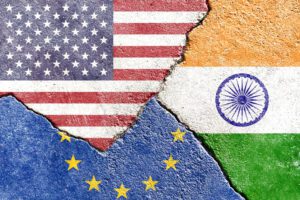
Two recent agreements, involving three of the world’s four largest and most important economies and concluded outside the WTO, spell the challenges the WTO faces in reversing its slide in relevance. First came the agreement between the European Union (EU) and India on January 26. Just a few days later, on February 2, President Trump announced he had struck a deal with Indian Prime Minister Narendra Modi, and the United States and India issued a joint statement with some details on February 6.
The EU and India pursued their agreement over many years and, while it is not a WTO agreement, it was concluded under cover of WTO rules on free trade agreements (FTAs). In stark contrast, the US-India agreement came together in less than a year, with plenty of dramatic moments in between, and is a manifestation of a Trump trade policy that deliberately thumbs its nose at WTO rules. Plenty of analysts and press reports suggested each was a reaction to the other. That could not be further from the truth. In fact, both the EU and the United States sought a more level playing field with India, which, historically, is known for its protectionist trade system. The two agreements could even prove complementary and mutually reinforcing of important reform efforts in India. However, what seems clear is that the WTO is an afterthought. Results on effective trade rulemaking now are coming outside the WTO, not inside.
03/10/2026 | Mark Linscott | The Hinrich Foundation
WITA – We put the community in trade community.
Information about upcoming WITA and trade community events