



WITA’s Friday Exchange: The Cul-de-sac Conundrum: China’s Excess Capacity, 301s, 308s, and the USMCA Reckoning
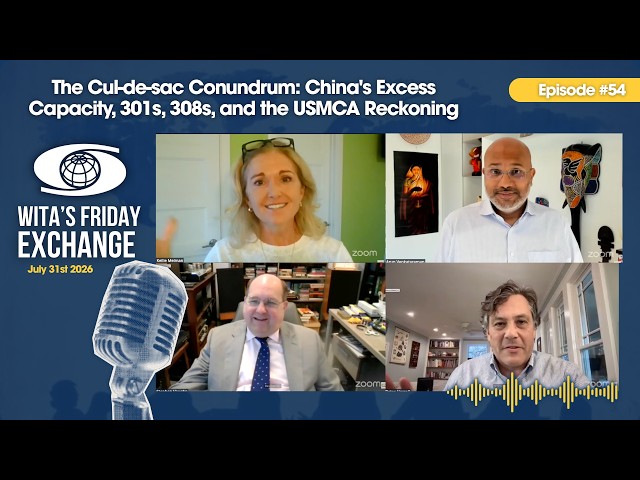
This week’s episode examines the legal durability of Section 301 tariffs and the untested Section 338s as tools for enforcing forced-labor and discrimination-based tariffs. The insiders weighed how each section could fare before the courts and what procedural gaps, like country-specific fact-finding, could weaken them on appeal. The panelists consider whether these actions are genuinely about changing trading partners’ practices or simply generating leverage against China. The conversation then turns to the state of the USMCA review, contrasting a relatively measured negotiating track with Mexico against a more contentious relationship with Canada shaped by ongoing rules-of-origin disputes and broader trade tensions. The panel wraps up with a discussion of China’s response to recent excess capacity claims and why the debate is likely to remain at the center of U.S.-China trade policy.
Featured Speakers:
Peter Harrell, Visiting Scholar, Georgetown Institute for International Economic Law; former Senior Director, International Economics, at the White House under President Biden
Stephen Vaughn, Partner, International Trade, King & Spalding LLP; former General Counsel, Office of the United States Trade Representative in the first Trump Administration
Arun Venkataraman, Partner, Covington & Burling; former Assistant Secretary of Commerce & Director General of the US & Foreign Commercial Service; and former Director for India and associate general council at USTR
Moderator: Kellie Meiman Hock, Senior Counselor, McLarty Associates; Adjunct Professor, Georgetown University; former Director of Brazil and the Southern Cone, Office of the United States Trade Representative
Watch on YouTube | Listen on Spotify | Listen on Apple Podcasts
Recorded at 9:00 AM US/ET on 07/31/2026 | WITA – The International Trade Association
USMCA and the Politics of Permanent Leverage
MEXICO CITY—Without much fanfare, U.S. and Mexican trade negotiators concluded a third round of bilateral USMCA talks in this city days ago. While progress was made on some issues, contentious topics such as auto industry rules of origin and nondiscriminatory access to Mexico’s electricity market are still sticking points that will be discussed in a new round scheduled for September in Washington.
Even as Mexico’s president, Claudia Sheinbaum, said on Friday that she had a “very good meeting” with the U.S. Trade Representative, Jamieson Greer, the reality points to a complex path for future negotiations where the parties involved will need to adjust to a new reality of constant and permanent leverage.
For decades, North American diplomacy sought to reduce friction among partners. Now, however, dialogue increasingly coexists with pressure. This is not incidental, but rather reflects today’s zeitgeist. Consider the closing ceremony of the FIFA World Cup. U.S. President Donald Trump stood alongside Mexico’s Sheinbaum and Canada’s Prime Minister Mark Carney. Three North American leaders, sharing the stage at the biggest sporting event ever jointly hosted by their countries, posed together before a global audience.
The image was meant to project unity, yet within hours, Washington announced a new 50% tariff on a broad range of Canadian exports. This made it even more evident that Canada is not participating in the trade talks of a de facto integrated North American market.
Read the Full Article Here
07/28/2026 | Brenda Estefan | Americas Quarterly
Beijing and Washington, DC Clash Over Excess Capacity: A Guide for the Bewildered

Excess capacity in China remains a major point of contention in business and policy discourse this year. Some governments and commentators connect it to trade tensions, global imbalances, deindustrialisation in China’s trading partners, and threats to their economic and national security.
Accusations of excess capacity in particular sensitive sectors, such as steel, were first levelled a decade or more ago. Now, some seek to delegitimise the entire Chinese economic system by contending that it is based almost entirely upon state measures that allow excess capacity to persist in manufacturing sectors. Combined with slow growth of domestic demand in China, this is said to result in China “venting” its surplus production on to world markets. The resulting Chinese export “surge” is said to be causing a “China Shock 2.0”. Such exports could not occur if there was insufficient production capacity, hence the contention that excess capacity is a driver of Shock 2.0.
Therefore, excess capacity is at the centre of this delegitimisation campaign. Careful analysts will have noticed that excess capacity is not the sole factor mentioned and that alternative explanations for Chinese export success and the upgrading of its firms ought to be considered. None of this is to deny that the Chinese state actively intervenes in its economy. What matters for businesses abroad and for trade policy deliberation is cross-border fallout from Chinese state measures and whether trading partners have tools that can effectively curb adverse fallout or the causes of such fallout.
Section 301 investigation: Excess capacity accusations widen beyond China
On 11 March 2026 the United States invoked Section 301(b) of the Trade Act of 1974 and opened an investigation into what the associated Federal Register notice calls “structural excess capacity in production and manufacturing sectors”. The investigation names sixteen jurisdictions: Bangladesh, Cambodia, China, the European Union, India, Indonesia, Japan, Malaysia, Mexico, Norway, the Republic of Korea, Singapore, Switzerland, Taiwan, Thailand, and Vietnam.
Read the Full Briefing Here
07/28/2026 | Simon Evenett | Global Trade Alert
China’s Position on the So-called Excess Capacity Issue
The following is a government position paper published by the Ministry of Commerce of the People’s Republic of China (MOFCOM), an agency of the Government of the People’s Republic of China.
Foreword
Providing strong dynamism for world economic growth, economic globalization is an unstoppable and overwhelming historical trend that promotes the flow of goods and capital, progress of science and technology and civilization, and exchanges among nations. As an important dimension to economic globalization, industrial cooperation is a key pathway to continuous global economic recovery and common development shared by all.
In recent years, international economic and trade landscape has gone through profound shifts with major-country rivalry intensifying and global industrial and supply chains reshaping quickly. With growing concerns about their industrial competitiveness and market positions, some countries and economies have politicized economic and trade issues. Hyping the so-called excess capacity of China, they accuse the country of flooding the world market with Chinese capacity and have used this as an excuse to ramp up restrictions on China, stoking up protectionism.
It has been China’s belief all along that the capacity issue requires a rounded, objective and just approach that combines historical perspective with dialectics to address contradictions and differences together in the spirit of openness, cooperation, mutual benefit and win-win outcome. Invoking protectionism will only serve to disrupt global economic and trade order and undermine the security and stability of global industrial and supply chains and the sound and orderly development of industrial cooperation, which spell long-term risks for world economic growth.
To clarify related facts, this document is hereby published to lay out China’s policy position on issues related to the so-called excess capacity.
Read the Full Government Position Paper Here
07/01/2026 | The Ministry of Commerce of the People’s Republic of China
U.S. Trade Law and Policy at a Crossroads
INTRODUCTION
The past decade has witnessed significant changes in U.S. international trade policy. In his first presidential term, Donald J. Trump moved the United States away from long-standing policies of lowering trade barriers to facilitate global commerce and replaced them with a more restrictive version not seen since the early twentieth century. President Trump’s more trade-restrictive policies were largely extended by his successor, President Joseph R. Biden. The first year of President Trump’s second term has indicated a strong desire to restrict imports further in an attempt to create U.S. manufacturing jobs and reduce reliance on Chinese imports.
This Article seeks to (a) situate recent changes in U.S. trade law and policy in a historical context, (b) argue that free trade policies are more consistent with America’s traditions of individual liberty than protectionist ones, (c) argue that free trade policies on balance better serve U.S. economic interests, (d) recommend changes to U.S. trade policies to enable their benefits to be more broadly shared, and (e) argue that changes in certain non-trade policies are needed to address real and perceived problems with post-World War II trade policies.
Read the Full Review Here
01/01/2026 | John K. Veroneau | University of Maine School of Law
WITA – We put the community in trade community.
Information about upcoming WITA and trade community events