


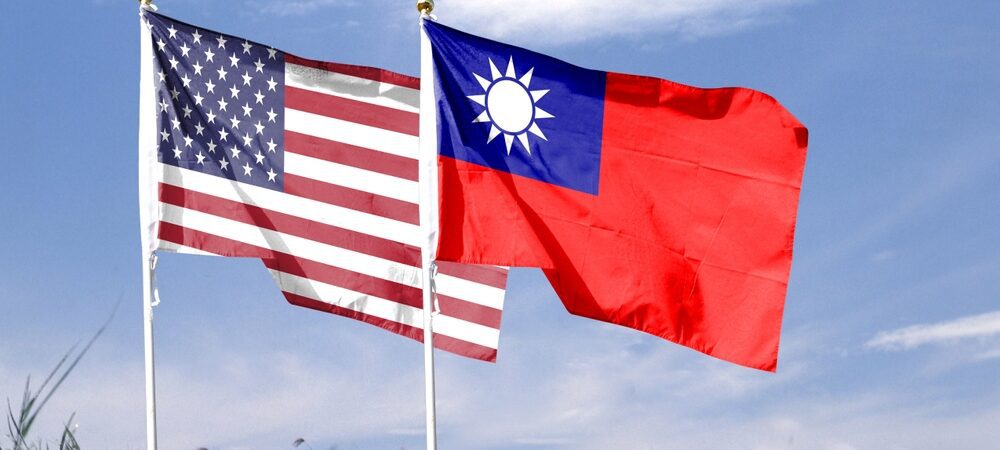
Taiwan has become only the seventh U.S. trading partner to reach a Reciprocal Trade Agreement with the Trump administration. Under the terms of the deal, the United States will reduce the reciprocal tariff rate on Taiwanese goods to 15 percent, Taiwan will reduce tariffs and non-tariff barriers, Taiwanese firms will invest at least $250 billion in the United States for semiconductor production, and Taiwan will guarantee $250 billion in credit for these companies. Taiwan also committed to increasing its purchases of American products, including $44.4 billion of liquefied natural gas and crude oil, $15.2 billion of aircraft and engines, and $25.2 billion of power-generation equipment.
The agreement should help bring much-needed predictability to a critical bilateral economic relationship and foster closer economic ties. At the same time, though, it is unlikely to resolve key issues. America’s trade deficit with Taiwan (the sole rationale for President Trump’s reciprocal tariffs) is set to expand. Differences over the extent to which chip production can and should be relocated to the United States will persist. Questions about Taiwan’s management of its currency, the New Taiwan Dollar (NTD), could grow. The AI boom, while underscoring Taiwan’s importance as a U.S. partner, may also exacerbate concerns about relying too much on the island to help fuel a critical driver of U.S. economic growth.
U.S.-Taiwan Trade Enters a New Era
U.S.-Taiwan trade relations have never been more robust. In 2025, Taiwan was the United States’ fourth-largest trading partner, trailing only Mexico, Canada, and China (in November 2025, the United States traded only $2.5 billion more with China than it did with Taiwan). According to Taiwan’s International Trade Administration, in 2025 Taiwan exported $198.27 billion in goods to the United States, up from $111.4 billion in 2024 (an increase of 78 percent). Taiwan’s exports to the United States have tripled since 2021, and the United States is now Taiwan’s top export destination.
Taiwan’s leading role in semiconductor production and information and communication technology (ICT) goods is largely driving this sharp rise in two-way trade. Taiwanese firms account for 60 percent of all foundry revenue and produce over 90 percent of the most advanced chips, while also exporting other ICT hardware to the United States. If the AI boom continues and the U.S.-China trade war intensifies, Taiwan may leapfrog China and become America’s third-largest trading partner.
While U.S.-Taiwan economic ties are set to deepen over the coming years, by the metric President Trump seemingly cares most about – bilateral trade balances – the relationship could also become tenser. Taiwan reported a bilateral trade surplus of $150.1 billion in 2025, more than doubling its surplus of $64.7 billion in 2024. Taiwan’s trade surplus with the United States has risen nearly six-fold since 2021. President Trump’s tariffs are premised on the notion that bilateral trade deficits constitute an emergency. Thus, the Office of the United States Trade Representative asserted that the deal “provides a tangible path forward with Taiwan that underscores the President’s dedication to bringing balanced, reciprocal trade with an important trading partner.” But it is difficult to see how the agreement will meaningfully reduce the bilateral trade deficit.
Reshoring Or Hollowing Out
One throughline from President Trump’s first term to the Biden administration and now to President Trump’s second term is the perceived need to reshore chip production to the United States. Undergirding this push is the desire to not be reliant on any single foreign source for chips that are vital to the U.S. economy and to national security. Put bluntly, the United States does not want to find itself in the position of being unable to fight a war over Taiwan because it cannot get the chips it needs for its weapons. The CHIPS and Science Act, signed into law in 2022, attempted to turbocharge these efforts by providing billions in funding for semiconductor manufacturing, workforce development, and research.
The Trump administration has continued to prioritize semiconductor manufacturing, but at the same time has rolled back funding for research and development and worker training (President Trump has called the CHIPS and Science Act “a horrible, horrible thing” and urged Congress to “get rid” of it). Due largely to the threat of tariffs, Taiwan Semiconductor Manufacturing Company (TSMC) increased its investment pledge to $165 billion, which will go toward chip fabrication and processing plants as well as a research and development facility in Arizona. Secretary of Commerce Howard Lutnick has shared that the Trump administration is seeking to bring 40 percent of Taiwan’s semiconductor supply chain to the United States. Lutnick added, “We’re going to bring it all over so we become self-sufficient in the capacity of building semiconductors.”
Such talk of self-sufficiency has raised concerns in Taiwan that its “silicon shield” is eroding and that the United States is seeking to make the island expendable. Wu Cheng-wen, the head of Taiwan’s National Science and Technology Council, has insisted Taiwan will not allow its chip industry to be “hollowed out.” Taiwan’s vice premier, Cheng Li-chiun, has stated that Lutnick’s goal is not realistic and that the island’s “most advanced R&D and manufacturing processes must be carried out first in Taiwan.”
Achieving the Trump administration’s onshoring goals will prove difficult. Over the course of decades, Taiwan has built and developed an ecosystem of critical supplier networks and human capital, which will be hard to replicate in the United States. In addition, manufacturing costs in the United States are higher than they are in Taiwan. TSMC has noted that talent shortages, equipment maintenance issues, and labor laws have presented challenges for its operations in Arizona. Nonetheless, TSMC recently announced that it intends to build up to 12 fabs in Arizona, up from the initial six announced in early 2025. The company is also introducing its advanced 2nm process a year earlier than planned.
While the Trump administration is determined to pursue reshoring and, according to reports, is weighing a tariff carve-out on chips tied to TSMC fulfilling its investment commitments, differences between the United States and Taiwan over the extent to which chip production can or should be reshored will likely persist. For Taiwan, this is a highly sensitive and salient political issue: Taiwanese people believe the island’s semiconductor prowess provides security and they fear that if the United States no longer needs Taiwan for chips, it will have less of an incentive to defend it from a Chinese attack.
To Intervene or Not to Intervene
Questions over Taiwan’s management of its currency, the New Taiwan Dollar (NTD), may prove to be a third sticking point in the U.S.-Taiwan trade relationship. Although Taiwan’s central bank maintains that it never targets a level for its currency, our colleague Brad Setser has pointed out the many creative ways in which the bank intervenes to keep the NTD low and make its exports more competitive. Most recently, Taiwan’s regulators changed policies to permit life insurance companies to reduce hedge ratios, creating dollar buying pressure that drives the currency down, which Brad Setser labels “backdoor currency manipulation.”
According to the Economist’s “Big Mac Index,” the NTD is 60 percent undervalued against the U.S. dollar, making it the most undervalued currency in the world (Taiwan’s central bank pushed back, calling the index “flawed and misleading”). As a result, according to the Economist, “in this century Taiwan has run the world’s biggest current-account surplus as a share of output, once entrepots and petrostates are excluded.”
The Trump administration has taken note. The U.S. Treasury Department placed Taiwan on its currency “Monitoring List” alongside nine other economies. In November 2025, the Treasury Department and Taiwan’s central bank released a joint statement pledging to avoid manipulating exchange rates for competitive advantage. In the joint statement, Taiwan also pledged to publicly disclose “any foreign exchange intervention operations on at least a quarterly basis.” Regardless, Taiwan’s management of its currency could well become an area of increased friction.
Kicking the Can
The conclusion of a U.S.-Taiwan Reciprocal Trade Agreement is good news. In theory, it should add some stability and predictability to the U.S.-Taiwan trade relationship and encourage closer economic ties. In a best-case scenario, TSMC continues to invest in the United States, its fabs in Arizona are successful, and the United States reshores enough chip production to at least provide for key national security applications. With greater access to Taiwan’s market, U.S. exports to the island grow.
At the same time, this agreement is unlikely to resolve the simmering issues between the two sides. Taiwan’s bilateral trade surplus with the United States is set to continue to increase, differences over reshoring remain, and questions about the value of Taiwan’s currency are growing. Whether the two sides can find common ground on these thorny issues will be a difficult task.
To read the article as it was published by the Council on Foreign Relations, click here.