


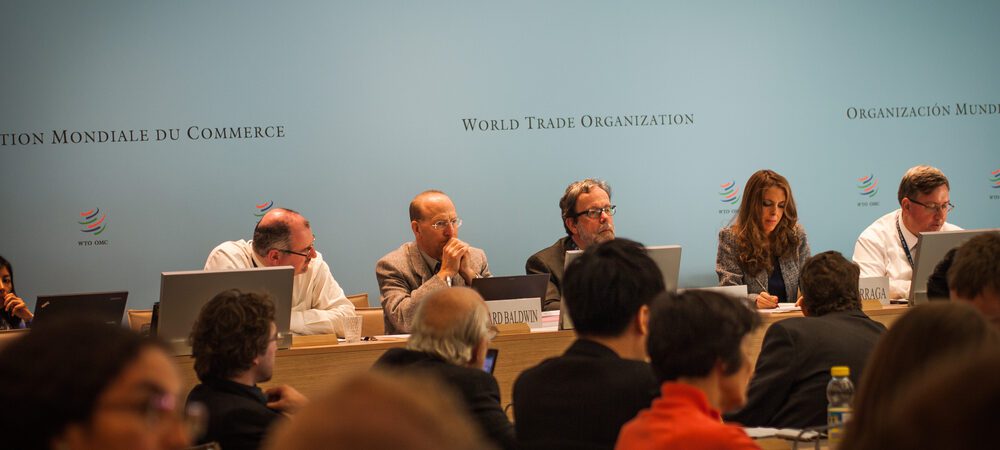
MC14 ended with a whimper. The latest Ministerial Conference (MC) for the World Trade Organization (WTO) took place over the weekend in Yaoundé, Cameroon.
Expectations of a successful summit were never high. Getting 166 members to agree on what a reform agenda would mean for the WTO was a tough challenge.1 In the end, nothing was decided, except to continue discussions. By the time members limped out of town and headed back to capitals and the WTO’s headquarters in Geneva, the institution was nearly unable to even hold a closing ceremony.
The ignominious failure of the global agenda, however, was offset by some important advancements alongside the meetings.
First, a substantial subset of members announced their intention to proceed with the implementation of an Electronic Commerce Agreement (ECA). The 66 participants pledged that they would start domestic ratification necessary to bring the deal into force.2
This is the long-awaited conclusion of work on digital trade, launched at MC11 (the WTO’s MCs are numbered by their biennial sequence) in 2017 under the leadership of Singapore, Australia, and Japan.3 At that time, members had grown increasingly concerned about the gap in global rules coverage for all things digital.
An early attempt at the WTO to tackle electronic commerce had led to just two outcomes. First, members agreed to a “moratorium” on customs duties for electronic transmissions. This agreement was put into place with a mandate to renew the moratorium every two years. Second, members started a workstream in 1998 to develop rules on all trade-related aspects of e-commerce.4
The work agenda within the WTO never really took off. The moratorium was renewed without much complaint in the early years after it was broached, but came to be seen as a useful “hostage” by some members to achieve their individual negotiating objectives in other areas. As a result, recent successive ministerial meetings were spent with increasingly tense, last-minute arrangements to keep the moratorium alive.
Now, however, the moratorium has officially expired. It could perhaps be renewed or renegotiated in Geneva in the coming weeks or months. But in the meantime, the lapse of the moratorium means that members will be legally allowed to impose customs duties (i.e., tariffs) on electronic transmissions. Members have always opted for a deliberately ambiguous term about what these transmissions mean, but it could be interpreted as any incoming digital file such as a software download, a newspaper subscription, or an update to the software in a refrigerator.
There is currently no practical way to collect tariffs on these activities. Even the one country that set up new tariff lines in their schedule to accommodate potential duties has no clear plan for implementation. Customs offices are simply not set up in any way to collect tariffs from digital trade.
The lapse of the moratorium will be seen as a bitter blow, particularly for business groups that have spent considerable time and resources defending it for decades.
However, all is not lost. In addition to the seemingly insurmountable practical problems of collecting tariffs on digital trade, an increasingly large number of WTO members have already promised to permanently avoid implementation of such duties.5 This includes the 66 members of the upcoming ECA.6 Other WTO members have made similar pledges in various free trade agreements (FTAs) and other arrangements.
The ECA also includes welcome updates to a host of other digitally important provisions such as enabling electronic trade through consistent legal rules for digital and paper-based activities, supporting online consumer protection, requiring domestic legal frameworks to protect personal data, providing a platform for additional cooperation on evolving issues, and supporting capacity development.
The ECA members had hoped to legally “anchor” the agreement into the WTO rulebook. But after multiple attempts to do so ran aground on objections from other members, particularly India, the ECA opted for pragmatism. It is a growing problem to have businesses continue to operate without consistent rules across the widest possible set of economies engaging in cross-border digital trade.
Hence, the ECA decided to simply get on with the job. Its participants will proceed with implementation at the domestic level. Once at least 45 members have notified that they comply, the deal will come into force. Between now and then, members will continue to address the mechanisms to bring the agreement more formally into the WTO rulebook for participants. They will also continue to accept new participants.
This sort of halfway house for the agreement is causing much legal head-scratching.7 But as any agreement requires domestic-level ratification and implementation to take effect, members have basically opted to start the approvals process and see what happens next.
The surprise decision by ECA members to simply proceed creates both a challenge to and an opportunity for the WTO.
The challenge is that members will continue to move agreements outside the organization. There is another, even larger, grouping of members that has been similarly sidelined. The 129 members of the Investment Facilitation for Development (IFD) Agreement have also made multiple attempts to anchor their arrangement into the WTO framework.8 They have also been consistently rebuffed, meeting with failure again in Yaoundé. The ECA has potentially provided a pathway forward for IFD, particularly as the approach does not require a ministerial or any other type of collective approval to proceed.
Another grouping of WTO members, the 27-member European Union (EU) and the 12-member Comprehensive and Progressive Trans-Pacific Partnership (CPTPP), also met on the sidelines of the WTO.9 They issued another call to action for the global organization but also made clear their intention to continue the EU and CPTPP’s own dialogue on topics like trade diversification and facilitation and supply chain resilience, digital trade, and the global trading environment.
The clear risk for the WTO is that more of such activity, particularly on topics of greatest relevance, means the WTO itself gets shunted out of what matters in global trade rules. Alternative arrangements can provide valuable outcomes to support global or regional trade and economic integration. The WTO could end up arguing over smaller and smaller issues or remaining tangled up with no path forward to address the biggest concerns like subsidies, services growth, or investment rules.
The opportunity is that WTO members finally grasp the nettle and figure out a reform agenda fit for purpose. The WTO, launched in 1995, has been unable to navigate the increasingly choppy waters of global trade. The three days spent by ministers and officials on the ground in Cameroon may be viewed by some as having been productive. Decisions by subsets of members in the ECA, EU-CPTPP, and elsewhere, may yet spur recognition that times have truly changed.
To read the article as it was published by The Hinrich Foundation, please click here.