



WITA’s Friday Exchange Podcast: Bizarro World Trade

In the latest episode of the Friday Exchange podcast, former trade negotiators look at the new trade deal between Taiwan and the United States, potential tariffs on countries that do business with Iran, and U.S. threats of a Greenland takeover. Our experts also discuss critical minerals, chips, USMCA, Venezuela, China and more.
Featured Speakers:
Introduction: Kenneth Levinson, CEO, WITA – The International Trade Membership Association
Kellie Meiman, Senior Counselor, McLarty Associates; former Director of Brazil and the Southern Cone at the Office of the U.S. Trade Representative
Daniel Mullaney, Non-Resident Senior Fellow, Atlantic Council; former Assistant U.S. Trade Representative for Europe and the Middle East, Office of the U.S. Trade Representative
Chris Padilla, Senior Advisor, Brunswick Group; former Under Secretary of Commerce for International Trade, U.S. Department of Commerce
Moderator: Wendy Cutler, Senior Vice President, Asia Society Policy Institute; former Acting Deputy U.S. Trade Representative, Office of the U.S. Trade Representative
Watch the Video on YouTube | Listen on Spotify or Apple Podcasts
Recorded at 9:00 AM ET on 1/16/2026 | WITA
Twenty Trends for 2026

Fusion & Flying Cars. Deaths From Despair. Blended Reality. AI Cyber War. Super Human. WITA is pleased to have hosted noted futurist Robert Moran of Brunswick Group to discuss 20 notable global trends and risks for 2026
Featured Speakers:
Robert Moran, Partner, Brunswick Group
Moderator: Rachel Rizzo, Senior Fellow, Strategic Studies Programme, Observer Research Foundation
Watch the Full Event Video Here
1/13/2026 | WITA
The Upcoming USMCA/CUSMA/T-MEC Review – The Options are: A Renegotiation, A Few Revisions, or a Formal Exit

On Thursday, January 22, WITA will host a webinar to look at where things stand with the USMCA review process. Information can be found here.
The exit of a country, such as the U.S., from the USMCA, well, that’s just crazy, right? Afterall, it’s a powerhouse of a trade agreement between the three nations. According to the U.S. International Trade Administration, the United States conducts over $1.3 trillion in annual trade with Mexico and Canada under the USMCA framework and supports roughly 17 million jobs across North America. The USMCA also currently supports record-breaking regional trade, with North America trading $1.8 million per minute. These figures include goods and services flowing both directions across the three economies. Mexico alone accounts f0r an estimated $900 billion in bilateral trade with the U.S. (based on the most recent U.S. Census data through Oct. 2025) Total two-way trade between the US and Canada for 2025 is estimated at around $800 billion. (U.S. Census data through Oct. 2025) This, among many other solid trade related economic reasons, such as decades in the making of supply chains, is why the USMCA is considered the backbone of North American economic integration. Ok, enough with the preliminary fluff, this agreement could be in trouble.
So, here we are, coming up on a six-year review in July of 2026, and the geopolitical landscape between the three countries is far less than stellar. The 25% tariffs slapped on Canada and Mexico back in March of 2025, was the first grenade thrown by the U.S. in the ensuing trade war, and retaliation comes in many forms, but Canada and Mexico have chosen to simply direct their energy and attention elsewhere around the globe. Granted, 85% of trade between the three countries was protected via the USMCA, but the tariffs made a statement to both Canadian Prime Minister Mark Carney and Mexico President Gloria Sheinbaum, and they get it, the U.S. is no longer a staunch ally regarding trade, which makes the USMCA seem more like a prayer moving forward, rather than a documented promise. If a country, like the U.S. does decide to exit, it must submit the formal documentation for departure 6 months in advance. As I tapped the keys writing that last statement, I shook my head in disbelief that something like this could actually happen. Of course, I never thought we would attack Venezuela, then tell Mexico they could be next, or simply say that “we don’t need Canada” and then tell them that they’d be better off if we just annexed their country. The acquisition of Greenland, and the U.S. not ruling out military force, wow, you have to be kidding. Mexico and Canada now look elsewhere for global trade partners, as the U.S. relationship is tentative with both at best. Afterall, USTR Greer explicitly said the U.S. could exit, revise, or renegotiate the agreement — “all of those things are on the table”. Idle threat or not prior to the July meeting, those words sink deep and were the catalyst for Mexico and Canada getting really busy making “other arrangements” for the sake of one’s economy. Trump has said he may renegotiate, let it expire, or scrap it entirely, and Carney, probably a little more than Sheinbaum is preparing for the worst.
01/12/2026 | Bob Brewer | JDSUPRA
Tee for Trumpism
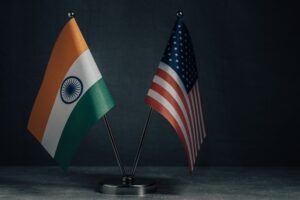
The following is an excerpt:
The success of Trump’s strategy — which is designed to rekindle the process of industrialisation in the US — will depend on how quickly he can ramp up economic growth, pare trade deficits with major partners, raise American wages, and increase the share of manufacturing in the $30-trillion US economy. Some green shoots of revival are starting to show: the US’s annual GDP growth in the third quarter (July-September) has surged to 4.3% — which is the highest in eight quarters since the 4.7% growth in the third quarter of 2023. However, it will be a while before the rationale for Trump’s minatory trade policy finds its validation in the other metrics.
Where does all this leave India?
The confabulations between the US and the Indian trade interlocutors have gone on for close to nine months — and we are still nowhere near a trade deal. Last month, the Union commerce minister, Piyush Goyal, said the two sides were in advanced stages of negotiation and that an initial framework deal would be finalised soon.
Data obtained from the US Census Bureau show that the US had a trade deficit of $47.1 billion with India in the first nine months of 2025 (Jan-Sept), which is 41% higher than the $33.4 billion in the same period in 2024. This could suggest that Trump’s tariff threats against Delhi have not really worked. India’s exports to the US in January-September have risen 24.6% to $80.1 billion against $64.3 billion in the same period in 2024. In contrast, India’s imports from the US have gone up by a piffle at 7% at $33.7 billion in Jan-Sept 2025 against $31.5 billion in the year-ago period. But there is a flipside to this narrative: the Bureau says that US exports to India in September hit a new record at $4.4 billion.
The US had announced a 25% tariff on Indian goods on July 31 last year and then topped it with another 25% in an attempt to force India to halt imports of crude oil from Russia. The claim is that India has been indirectly greasing Russia’s war machine enabling President Vladimir Putin to attack Ukraine — an argument that loses its legitimacy because the levy is discriminatory. The Trump administration does not penalise China which buys much more crude oil from Russia than India does.
01/09/2026 | Saumitra Dasgupta | The Telegraph Online
Greenland, Rare Earths, and Arctic Security

Just one day after the U.S. raid in Venezuela and capture of Nicolas Maduro, President Trump turned his sights northward to the island of Greenland. On January 5, President Trump affirmed, “we need Greenland from the standpoint of national security.” Senior Trump aides soon echoed the assertion the United States could seize the Danish territory to support national interests. These recent comments mark a return to rhetoric that made headlines in the early days of 2025, as the newly re-elected President Trump declared the United States could purchase the autonomous Danish territory. The renewed focus on Greenland underscores the Trump administration’s approach to resource security as national security.
Greenland is rich in natural resources including iron ore, graphite, tungsten, palladium, vanadium, zinc, gold, uranium, copper, and oil. But the resources attracting the most attention to the region are rare earth elements (REEs). Vulnerabilities in U.S. REE supply chains for defense and commercial needs have recently been at the forefront of policy issues in Washington. Notably, 2025 was marked by multiple rounds of high-stakes negotiations following Chinese export controls on heavy REEs. Disruptions to these materials exposed Western automotive supply chains to shortages, delays, and pauses in production. President Trump has acted meaningfully to address these prescient supply chain concerns both through public-private partnerships, such as the equity deal with U.S. rare earth company MP Materials, and bilateral agreements with partners including Saudi Arabia, Japan, and Australia to further the development of rare earth capabilities outside of China. Deepening cooperation and commercial ties with mineral-rich countries is expected to be a cornerstone of U.S. foreign policy in 2026.
01/08/26 | Meredith Schwartz & Gracelin Baskaran | Center for Strategic & International Studies
WITA – We put the community in trade community.
Information about upcoming WITA and trade community events