



WITA’s Friday Exchange: The Three B’s: Trade Defense, Overcapacity, and Global Tensions
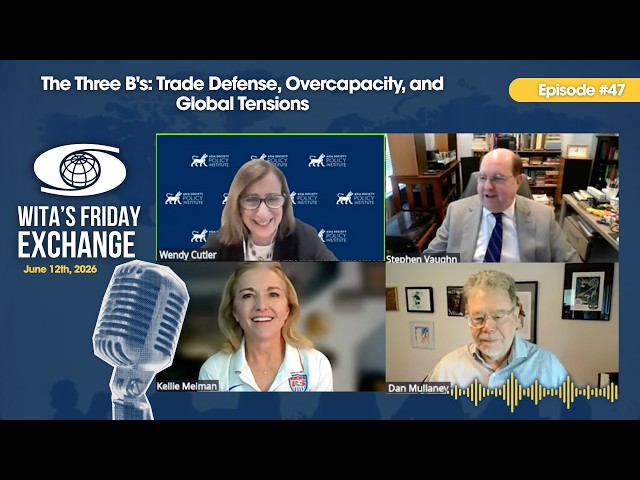
This week’s episode is a “travel log” edition as our panel returns fresh off trips to Beijing, Brussels, and Berlin. The discussion explores rising concerns over China’s industrial overcapacity, the expanding use of trade defense tools like Section 301, and the legal and policy timelines shaping upcoming U.S. tariff actions.
In Europe, policymakers are balancing stability under recent trade arrangements with growing pressure to adopt stronger responses to China, while also managing tensions in their relationship with the United States. In China, officials continue to emphasize “comprehensive strategic stabilization” following recent diplomatic engagement, even as trade imbalances and export growth remain central concerns.
The panel also examines emerging alignment between the U.S. and Europe on trade enforcement tools, alongside political and rhetorical friction that complicates cooperation. Finally, they discuss uncertainty around USMCA and the likelihood of renewed negotiation pressure rather than formal withdrawal.
Wendy Cutler, Senior Vice President, Asia Society Policy Institute; former Acting Deputy U.S. Trade Representative
Daniel Mullaney, Non-Resident Senior Fellow, Atlantic Council; former Assistant U.S. Trade Representative for Europe and the Middle East
Stephen Vaughn, Partner, International Trade, King & Spalding LLP; former General Counsel, Office of the United States Trade Representative under first Trump Administration
Kellie Meiman Hock, Senior Counselor, McLarty Associates; Adjunct Professor, Georgetown University; Board Member, Inter-American Dialogue; former Director of Brazil and the Southern Cone, Office of the United States Trade Representative
Watch the Video on YouTube | Listen on Spotify or Apple Podcasts
Recorded at 9:00 AM US/ET on 06/12/2026 | WITA – The International Trade Association
How AI and Innovation Drive U.S. Exports

At this WITA Zoom webinar, our speakers discussed how AI‑enabled digital trade platforms are expanding global market access for U.S. businesses, how AI is lowering barriers to exporting and transforming supply chains—and why digital trade, technology investment, and smart trade policy are critical to U.S. exports and job creation.
Featured Remarks:
Bill Guidera, Deputy Under Secretary for Innovation and Engagement, International Trade Administration, U.S. Department of Commerce
Panel Discussion:
Zach Fishbain, Chief Executive Officer, Spread The Love LLC
Scott Jacobs, Head of Global Public Policy, Coupang
Kristin Najdi, Senior Director of Trade Policy, Information Technology Industry Council
Brian Scarpelli, Senior Global Policy Counsel, Association for Competitive Technology (ACT)
Moderator: Scott Friedman, Vice President, Government Affairs, Altana
06/11/2026 | WITA – The International Trade Association
From Rules to Discretion: How Trump Reconfigured US Tariff Policy

Introduction
President Donald Trump’s “America First” trade policy did not just produce the largest increase in tariff rates in decades. It also marked a structural change in how U.S. tariffs are used and governed, altering their scope, function, and governance in ways that are likely to last beyond the end of the president’s term. The Trump administration relied on multiple statutory authorities, deploying country- and industry-specific measures toward a range of objectives, while introducing novel design features such as tariffs based on the value of embedded inputs and tariffs contingent on firm-specific commitments. Over time, exemptions and adjustments to country-level tariffs further reshaped their effective coverage.
The result is a tariff regime that is more administratively complex and less predictable than the system that preceded it—less anchored in fixed commitments and more contingent on presidential discretion. Market access is more conditional across partners and more responsive to political and economic pressures. This more flexible and active approach has given the administration a powerful tool of economic statecraft, turning tariffs from primarily economic policy instruments into tools for pursuing a broader and more discretionary set of foreign policy and national security goals.
For firms making long-term decisions about sourcing, hiring, investment, and production, the implications extend beyond the level of duties to higher compliance costs. Origin, classification, and eligibility are now central to strategic decisionmaking for manufacturers and downstream firms alike. This new approach also introduces greater uncertainty over the duration, scope, and application of tariffs. A framework intended to promote domestic manufacturing capacity, economic security, and bargaining leverage may, in practice, introduce costs and instability that undermine those objectives.
All this represents a significant break from the assumptions and practices that governed the post-war trading system. It is the baseline that the next set of decisionmakers will inherit. It will shape choices within this administration, in the next presidential administration, and in Congress as it considers the role of legislation in defining trade authority. It will also shape how the United States interacts with trading partners, how firms organize production and investment, and how economic tools are used in geopolitical competition.
Read the Full Policy Brief Here
06/09/2026 | Kari Heerman & Asha Patt | Brookings Institution
Resetting UK Politics 10 Years On – Recognise Today’s Economy

WITA International is partnering with Borderlex to host the 2026 Borderlex UK Trade Policy Academy, taking place on 16–17 June 2026 in London. David Henig is a featured speaker at this event.
The UK had five Prime Ministers in the 35 years prior to the June 2016 EU referendum, since when it has had six which seems likely shortly to become seven. While correlation and causation are not the same, at the very least Brexit has not helped UK political stability. In particular it sent the leaders of a trading, inter-connected global economy into a nostalgic insularity from which it has yet to escape.
That 2016 vote is seen across Europe as the first major event in the continental rise in a nationalist populism driven by various factors including slow economic and living-standard growth, ageing populations, rising social media, declining manufacturing, and migration concerns. This is not however the predominant view of a UK commentariat which prefers to see the 52:48 decision as part of an ongoing argument about European integration that shouldn’t affect anything else.
Where this has led is UK politics as a rather warped variant of the Truman show in which simplistic answers are the attempted escape from talking about EU relations. Global trade deals can never be as deep or cover as much of the UK’s economy as EU relations. Inflation is persistently higher in part due to the loss of the flexible labour force that came from freedom of movement. Attempts to deregulate for growth run into a problem of that increasing trade costs with the EU, as well as bringing into question UK stability.
Successive governments have particularly taken from the referendum the view that migration must be controlled, have proclaimed that this is their priority, and then failed to deliver. There are obvious reasons for this, not least that a services economy with famous universities requires inbound movements, and that returning migrants to France is rather difficult outside of the EU. All of which brings UK politics into further disrepute as ever bigger promises are made and broken.
Read the Full Policy Brief Here
05/31/2026 | David Henig | European Centre For International Political Economy
In Memoriam: Richard Burleson Self, 10/08/1943-05/10/2026

The following is a brief remembrance of Richard Self by Dorothy Dwoskin, former Assistant US Trade Representative for WTO and Multilateral Affairs, at the Office of the United States Trade Representative. A funeral mass will be held at All Souls Episcopal Church in Washington, DC on June 22, at 10:30 a.m.
“A great friend, colleague and excellent trade negotiator, Dick passed away in May. Dick had a storied trade career, working at Treasury, the House Committee on Ways and Means and USTR. While best-known for his groundbreaking work on Services and the creation of the General Agreement on Trade in Services (GATS), he worked on a wide range of trade issues throughout his career.”
Richard Burleson Self, known to most as Dick, died on 10 May, 2026, at the age of 82 from complications due to Alzheimer’s. Dick was born in Oklahoma City, Oklahoma on 8 October, 1943, the second of two children, to Dr. J. Teague and Mrs. Ida Self. Growing up in the university town of Norman, he was a lifelong Sooner fan. The son of a zoology professor and school librarian, Dick was surrounded by intellect, curiosity, and an eternal love of faith and family. He was blessed with an extended family of deep Texas roots which included many dear aunts, uncles and cousins. He and his beloved sister, Virginia, spent their happiest childhood summers at the University of Oklahoma Biological Station at Lake Texoma. Together, they nurtured many cherished pets, including the famed “Woofus.”
06/01/2026 | Dorothy Dwoskin | Dignity Memorial
WITA – We put the community in trade community.
Information about upcoming WITA and trade community events