


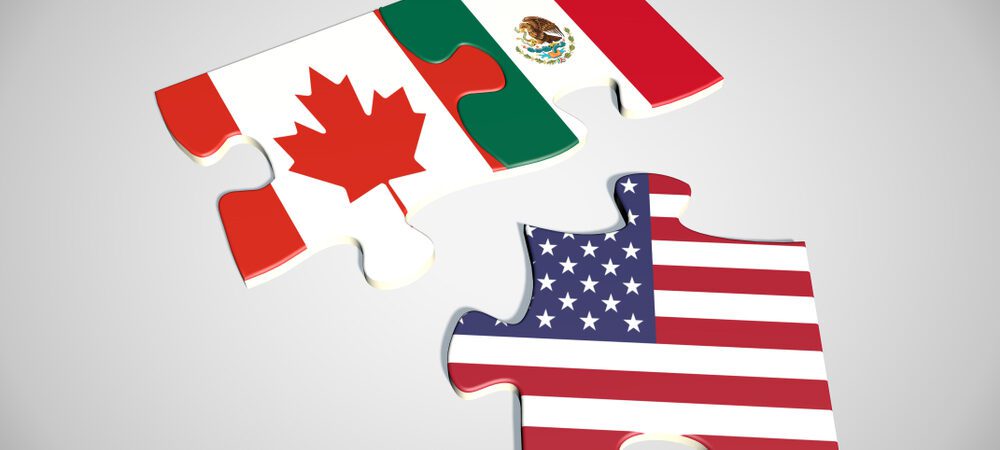
The 2026 review of the United States–Mexico–Canada Agreement (USMCA) will be a turning point for North American integration. This is not merely a technical update of chapters and annexes: it will unfold in a moment of heightened protectionism, intensified great-power competition, and domestic political pressure in Washington. For Mexico, the challenge is twofold: to preserve legal certainty and market access under the agreement, while using the review as a platform to strengthen supply chains, modernize trade rules, and consolidate North America as a competitive and resilient economic bloc.
The Geopolitical Environment
Early 2026 is defined by a tougher US foreign policy posture toward Latin America. The region is increasingly framed through a “hemispheric security” lens where three concerns converge: migration management, transnational organized crime, and China’s expanding economic footprint. Within this broader landscape, Venezuela has served as a catalyst. The detention of Nicolás Maduro during a US operation, subsequent actions targeting Venezuelan oil flows, and maritime interdictions in the Caribbean have conveyed a clear message: Washington’s threshold for direct action has shifted. Regardless of political interpretations, the strategic consequence is undeniable — security priorities can override economic routines, and trade tools may be leveraged in service of geopolitical objectives.
For Mexico, Venezuela matters primarily through indirect effects. First, it reinforces a model of statecraft that blends economic coercion with political pressure. Second, it heightens uncertainty across Caribbean energy routes, while increasing the strategic value of logistical alternatives inside North America — land corridors, rail expansion, and near-market industrial platforms. Third, it pushes Latin American countries to rebalance their external relationships, creating space for China to deepen its commercial, infrastructure, and technology presence across the region.
Migration is another structural driver. More restrictive processing of visas, intensified border enforcement, and a security-dominant narrative increase the probability that the USMCA review will be accompanied by parallel demands for measurable migration outcomes. In practice, this may become an implicit trade-off: tariff relief and commercial stability in exchange for stronger cooperation on border management and security.
As a result, the USMCA review must be understood as a broader negotiation where trade, security, and regional governance are increasingly intertwined.
Trump, Tariffs, and Negotiation as a Competitive Advantage Strategy
Donald Trump’s comments suggesting that the USMCA is not essential — and his preference for negotiating separately with Mexico and Canada — reflect a recurring method: extracting visible advantages for the United States through targeted pressure. Recent tariff actions reveal a pattern: identify a politically sensitive sector, raise the cost of access to the US market, and then offer a conditional negotiating channel. This approach changes the tone of the 2026 process. Rather than a cooperative modernization exercise, the review could evolve into a high-stakes leverage game where concessions are treated as transactional currency.
Mexico must begin with a realistic premise: domestic narratives in the U.S. will heavily shape negotiating demands. The review will be framed around industrial employment, economic security, and supply chain control. Mexico’s strategy therefore must convert interdependence into a decisive argument: the USMCA is not a concession to Mexico, it is a regional architecture that lowers costs, stabilizes supply, and sustains the competitiveness of US industries that depend on integrated production networks across Mexico and Canada. The central objective is to defend North American integration with empirical evidence on jobs, investment flows, and strategic competitiveness.
China, Canada, and ‘Strategic Origin’
At the same time, Canada’s engagement with China introduces an additional variable. Ottawa’s interest in diversifying markets may intensify Washington’s pressure to restrict Chinese inputs in North American supply chains. In this environment, “rules of origin” will no longer be only a question of percentage thresholds; they will increasingly become a question of strategic traceability in sectors such as steel, auto parts, semiconductors, batteries, and critical minerals. Mexico’s risk is to absorb the costs of US-China rivalry without securing the corresponding benefits — investment inflows, technology transfer, and stable long-term market access.
What Mexico Must Consider
First, rules of origin and advanced manufacturing. Mexico must defend the continuity of integrated automotive and industrial production, while proposing a credible plan to deepen regional content: supplier development for Tier-2 and Tier-3 firms, targeted financing for SMEs, workforce upskilling, and realistic transition timelines that avoid disrupting production flows. The goal is to raise regional value content without sacrificing competitiveness.
Second, Alternative Dispute Resolution (ADR). Mexico needs stronger legal certainty: binding, efficient, and enforceable procedures. Institutional predictability supports investment, reduces risk premiums, and limits unilateral actions that distort trade conditions across the bloc.
Third, energy and industrial transition. The energy chapter should be reframed as a competitiveness agenda: regional energy security, grid expansion, natural gas as a transition fuel, renewable capacity growth, and industrial electrification. If Mexico links energy policy to nearshoring and productivity, it can transform a recurring source of friction into a forward-looking regional program.
Fourth, agriculture, sanitary measures, and biotechnology. The conflict over genetically modified corn and related restrictions requires a calibrated solution: protect biodiversity and food identity, while enabling controlled imports for industrial purposes, strengthening traceability systems, and creating joint scientific cooperation frameworks. The objective is to prevent retaliatory actions and stabilize a politically sensitive sector.
Fifth, digital trade, data flows, and artificial intelligence. The review must modernize rules on cross-border services, data protection, cybersecurity standards, digital payments, and AI governance. Mexico should propose concrete frameworks so it does not remain a passive recipient of external standards—particularly in logistics, fintech, and e-commerce.
Sixth, labor and environmental commitments framed through productivity. Mexico can reduce disputes by launching regional compliance programs, supplier certification pathways, preventive audits, and capacity-building initiatives aimed at formalization and productivity growth. This strengthens reputational credibility, reduces enforcement risk, and supports higher value-added exports.
Seventh, migration and security as the parallel agenda. Even if not formally codified inside the treaty text, negotiations will incorporate commitments related to customs modernization, high-risk cargo traceability, cooperation against criminal networks, and regulated labor mobility. Mexico should promote temporary sector-based work visa schemes and structured mobility channels that reduce irregular migration pressure while supporting labor needs across North America.
Reinforce the Bloc, Prepare Contingencies
The priority must be to preserve a trilateral framework and coordinate closely with Canada. A unified front increases leverage and keeps the USMCA as the foundation for regional stability. In parallel, Mexico should deploy an adaptive tariff policy: selective, temporary, and proportional countermeasures, with built-in de-escalation mechanisms to avoid uncontrolled trade escalation.
Infrastructure and logistics should be part of the negotiating narrative. Freight rail expansion, port modernization, and the Interoceanic Corridor can be presented as North American supply chain security — an alternative capacity layer in a world exposed to maritime disruptions. Mexico should also reinforce domestic institutional certainty: clear rules, credible regulators, and trustworthy courts are strategic assets in both negotiation and investment attraction.
Conclusion
The USMCA review should be approached as an opportunity to shield North America from geopolitical shocks—not as a backward-looking audit. Mexico can transform uncertainty into modernization if it arrives with coherent proposals, coordinated regional positioning, and technically grounded negotiation capacity. The central balance is clear: strengthen the bloc’s competitiveness while managing political pressures and reducing structural risks. If Mexico navigates this effectively, the region can emerge not only as a major market, but as a global leader in resilient, integrated economic governance.
To read the full review as it was posted on Mexico Business News : Click Here